Key Takeaways
- Price range: $1,700–$4,200 for standard passenger vehicles (unit only); $3,000–$7,000+ total installed cost
- Key cost drivers: Transmission type (CVT and dual-clutch cost more), vehicle make/model, labor complexity, and warranty tier
- Cost by segment: Standard domestic vehicles sit at the low end; luxury brands (BMW, Audi), diesel trucks, CVTs, and hydrostatic/industrial units run $7,000–$15,000+
- Best value: Remanufactured units beat used transmissions on reliability and warranty coverage — worth it when predictability matters more than the lowest sticker price
How Much Does a Remanufactured Transmission Cost?
Remanufactured transmissions do not carry a fixed price. Costs shift significantly based on vehicle class, transmission complexity, and whether the quote includes installation, fluid, and warranty.
Two common budgeting mistakes:
- Assuming the unit price is the total cost — Many buyers ignore labor ($1,100–$1,600) and ancillaries (fluid, torque converter, core charge), which can add $500–$1,200 to the final bill
- Confusing "remanufactured" with "rebuilt" — Rebuilt transmissions are shop-dependent and typically replace only failed parts; remanufactured units are factory-restored with all wear parts replaced to OEM spec, often costing $300–$800 more but offering superior consistency and warranty protection
Automotive Standard (Most Passenger Cars and Light Trucks)
For common domestic and import vehicles (Ford, GM, Toyota, Honda), remanufactured transmissions offer predictable pricing and wide availability.
Current Price Range (Unit Only):
- Ford F-150: $1,820–$3,300
- Chevrolet Silverado 1500: $1,690–$3,170
- Toyota Camry: $1,745–$4,160
- Honda Accord: $1,995–$3,145
What's Included:
- Fully disassembled, cleaned, and inspected unit
- New seals, gaskets, and all wear items (clutch packs, bands) replaced to OEM spec
- Remanufactured and dyno-tested torque converter (from reputable suppliers like JASPER and Fraser)
What's Excluded:
- Installation labor ($1,100–$1,600)
- Transmission fluid ($100–$175 for 10–14 quarts of premium synthetic ATF)
- Core charge deposit ($350–$1,000, refundable when old unit is returned)
Best-Fit Use Case: Vehicles under 15 years old, common makes with widely available parts, owners planning to keep the vehicle for several more years.
Automotive Luxury and High-Performance
Luxury and performance vehicles (BMW, Mercedes-Benz, Audi, Porsche) carry significantly higher remanufacturing costs due to proprietary technology and lower rebuild volume.
Price Range (Unit Only):
- BMW ZF 8HP (2024 models): ~$8,600
- BMW 5HP-24 (older models): ~$4,800
- Audi S-Tronic/DSG mechatronic units: $3,800–$4,250 (plus $400–$520 core charge)
Why Costs Are Higher:
- Combined valve body and TCM units are often VIN-coded, requiring specialized reprogramming or "virginizing" before installation
- Fewer units in circulation drives up per-unit remanufacturing costs compared to high-volume domestic platforms
- Installation requires dealer-level diagnostic tools and software calibration, adding to total labor cost
Best-Fit Use Case: Luxury vehicle owners for whom a new OEM transmission ($12,000–$18,000+) is out of reach but who still want factory-equivalent quality and comprehensive warranty coverage.
Industrial and Heavy Equipment (Including Hydrostatic Transmissions)
The jump from passenger vehicles to heavy equipment isn't just a price increase — it's a different category of complexity entirely.
Industrial, construction, and agricultural equipment face steep remanufacturing costs, particularly for hydrostatic systems used in skid steers, tractors, and mobile equipment.
Price Range:
- Case IH combine transmissions: ~$7,250 (plus $1,500 core charge)
- Hydrostatic modules (John Deere tractors, skid steers): $7,500+ for module alone
- Kubota remanufactured rear-half transmissions: $1,500–$5,500
The Hydrostatic Premium: Hydrostatic transmissions carry a premium due to:
- Pumps and motors require extreme machining precision — tolerances that general rebuild shops often can't hold
- Parts availability is thin for specialized manufacturers, which extends lead times and raises sourcing costs
- Every unit must be dyno-tested under load to verify correct flow and pressure before shipping
Best-Fit Use Case: Fleet operators, manufacturing facilities, or heavy equipment owners where downtime costs far outweigh the unit price — reliability and fast turnaround are the priority over finding the lowest price.
For hard-to-source manufacturers, the supplier's parts database matters as much as their shop capability. Hydrostatic Pump Repair maintains an extensive OEM parts reference across thousands of manufacturers — which cuts lead time compared to general shops sourcing unfamiliar components on the open market.
Key Factors That Affect Remanufactured Transmission Cost
Pricing is shaped by a combination of technical, logistical, and market factors. Understanding them helps avoid sticker shock and makes vendor quotes easier to compare.
Transmission Type and Complexity
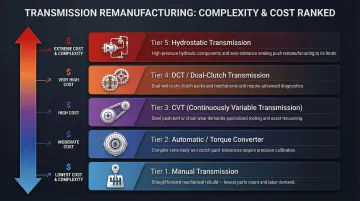
Different transmission designs carry vastly different remanufacturing costs:
- Automatic (torque converter): Moderate complexity. Remanufacturing involves replacing clutch packs, bands, seals, and testing the valve body and torque converter.
- Manual: Least expensive. Focus on replacing synchronizers, bearings, and seals.
- CVT (Continuously Variable Transmission): High cost. CVTs rely on precision-machined pulleys (variators) and specialized push-belts or chains. Wear on these components often requires complete replacement, driving up costs.
- DCT (Dual-Clutch Transmission): Very high cost. DCTs combine manual gearsets with complex, proprietary electro-hydraulic mechatronic units that require precise calibration and software matching.
- Hydrostatic: Extremely high cost due to the tight tolerances of hydraulic pumps and motors used in heavy equipment.
Vehicle or Equipment Make, Model, and Age
High-volume, common platforms (e.g., Ford F-150, Chevrolet Silverado) have lower remanufacturing costs due to parts availability and established rebuild processes. Rare, discontinued, or import models cost more because sourcing parts is harder and technician expertise is scarcer.
Examples:
- A 2015 Ford F-150 with a 6R80 transmission benefits from widespread parts availability and standardized rebuild procedures, keeping costs in the $1,800–$3,300 range.
- A 2012 Audi S4 with a DSG transmission requires specialized mechatronic components and VIN-specific programming, pushing costs to $3,800–$4,250 for the mechatronic unit alone.
Extent of Core Damage and Core Charge
A core charge is the deposit required when purchasing a remanufactured unit, refunded when the old (core) unit is sent back in acceptable condition.
Typical Core Charges:
- Passenger vehicles: $350–$1,000
- Heavy equipment: $1,500+
Refund Conditions: To receive a full refund, the core must be:
- A like-for-like model (same transmission type)
- Drained of all fluids
- Fully assembled (no missing parts)
- Securely strapped to the original shipping skid
- Free of visible holes or cracks in the case
Damaged Core Penalties:
- Visible holes or cracks: 50% deduction
- Missing parts: 25% deduction
- Non-rebuildable condition: Full forfeiture of core charge
Parts Sourcing and Availability
Remanufacturers who have access to OEM-equivalent or hard-to-find parts for uncommon manufacturers can complete the job without substituting inferior aftermarket components. This affects both price and long-term reliability.
For industrial and hydrostatic applications, the right specialist makes a direct difference in both turnaround and outcome. Hydrostatic Pump Repair, for instance, maintains a comprehensive parts inventory for hard-to-find manufacturers, reducing lead time and keeping part fidelity to OEM standards — critical for equipment that general shops typically decline due to parts scarcity.
Warranty Terms
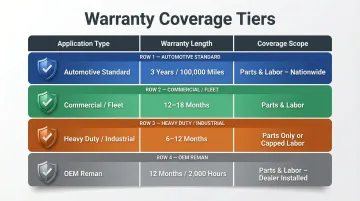
Longer, more comprehensive warranties (covering parts and labor) add to the unit cost but reduce long-term financial risk.
Typical Warranty Coverage:
| Application Type | Warranty Length | Coverage Scope |
|---|---|---|
| Automotive Standard (JASPER, ATK) | 3 years / 100,000 miles | Parts & labor (nationwide) |
| Commercial/Fleet | 12–18 months / 12,000–100,000 miles | Parts & labor |
| Heavy Duty/Industrial (over 1 ton) | 6–12 months | Parts only or capped labor |
| OEM Reman (e.g., John Deere) | 12 months / 2,000 hours | Parts & labor (dealer installed) |
Important: Labor reimbursement is often capped (e.g., $50/hour) unless a premium "No-Fault" or upgraded service plan is purchased.
Full Cost Breakdown: What You're Actually Paying For
The quoted unit price is rarely what you'll pay at the end. Between core charges, labor, fluid, and ancillary parts, total installed cost typically runs $500–$1,500 above the sticker price — sometimes more for heavy equipment or difficult-access vehicles. Here's where that money actually goes.
Unit Purchase (One-Time)
The cost of the remanufactured transmission itself — this is the largest single line item and varies by tier as covered in the pricing section above. This typically includes internal parts replaced to OEM spec but may or may not include the torque converter.
Ask upfront: Does the unit price include a remanufactured torque converter? If not, budget an additional $100–$225 for a standalone remanufactured converter.
Core Charge (One-Time / Refundable)
Most suppliers require a core deposit — this is refunded when the old unit is returned in acceptable condition.
Confirm the acceptable condition requirements in writing before purchasing. Cores with cracked cases, seized internals, or missing components often receive partial refunds or none at all.
Labor and Installation (One-Time)
Transmission removal and installation (R&R) is labor-intensive and varies based on vehicle accessibility.
Typical Labor Costs:
- Average labor portion: $1,100–$1,600
- RWD trucks (e.g., Ford F-150 4x4): 6.6–9.8 hours of labor
- Heavy equipment (e.g., John Deere power shift transmission): 17.0–25.5 hours
Some models require removing subframes, exhaust systems, or transfer cases just to access the transmission — that additional disassembly can add several hours to the job.
Transmission Fluid and Ancillary Parts (One-Time)
Fresh transmission fluid, a new filter, and potentially a new torque converter or solenoids add to the total.
Cost Breakdown:
- Transmission fluid (ATF): $100–$175 for a full dry-fill (10–14 quarts at $10–$14/qt)
- Torque converter (if separate): $100–$225 (remanufactured), plus $10–$75 core charge
- Solenoids (if needed): $250–$750 installed; individual parts range from $24–$246
Pro Tip: Always replace the torque converter during a transmission swap. A contaminated old converter can ruin a new transmission within weeks.
Maintenance and Fluid Service (Recurring)
Remanufactured transmissions require periodic fluid changes to maintain the warranty and extend lifespan.
Service Intervals:
- Initial service (first 5,000 miles): Change fluid and filter to flush break-in materials
- Recurring service: Every 30,000–60,000 miles (despite "lifetime fluid" marketing claims)
Service Costs:
- Basic drain-and-fill: $230–$290
- Comprehensive fluid and filter change (pan removal): $560–$730
Warranty Requirement: Most remanufacturers require proof of maintenance (receipts) to process warranty claims. Neglecting fluid service can void coverage.
Remanufactured vs. Rebuilt vs. Used Transmission: What's the Cost Difference?
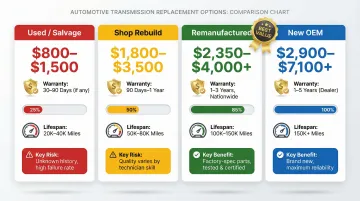
When facing transmission failure, buyers generally have four options. The table below breaks down typical costs, warranty coverage, and expected lifespan to help you compare them at a glance.
| Transmission Option | Estimated Cost Range | Typical Warranty | Expected Lifespan | Key Considerations |
|---|---|---|---|---|
| Used / Salvage | $800–$1,500 | 30–90 days | Unknown | Cheapest option; unknown service history; high risk of hidden wear; minimal warranty |
| Shop Rebuild | $1,800–$3,500 | Varies (shop-dependent) | 50,000–100,000 miles | Retains original case; replaces only visibly worn parts; quality depends entirely on the local builder's skill |
| Remanufactured | $2,350–$4,000+ | 3 years / 100,000 miles | 100,000–150,000+ miles | Factory restored to OEM specs; all wear parts replaced; dyno-tested; nationwide warranty |
| New OEM | $2,900–$7,100+ | 3 years / 100,000 miles | 150,000–200,000+ miles | Highest cost; brand new components; full dealer warranty |
When a Remanufactured Unit Is the Better Financial Choice:
A remanufactured unit makes more sense than a rebuild when:
- Complex units (CVT, DCT, hydrostatic) require specialized equipment most local shops don't have
- A 3-year/100,000-mile nationwide warranty protects against repeat repair costs — shop rebuilds typically offer 1 year/12,000 miles
- Commercial and industrial operators can't absorb a second failure within months; remanufactured units reduce that risk
The Key Risk with Used Transmissions:
Used transmissions are a false economy in many cases due to:
- No way to verify maintenance history or why the unit was pulled from service
- Most used units carry only 30–90 day warranties — a short window before you're on your own
- Internal wear may be near end-of-life, meaning failure can occur shortly after installation
A remanufactured unit eliminates that uncertainty: fixed cost, known condition, and a warranty that covers you for years rather than weeks.
How to Estimate the Right Budget — and What Most Buyers Get Wrong
Before getting quotes, answer these key questions:
- What is the transmission type and vehicle/equipment class?
- Is the quote all-in (unit + core + labor + fluid) or unit-only?
- What warranty is included, and does it cover labor?
- What is the cost of downtime if the unit fails again?
Common Mistake #1: Focusing Only on the Unit's Sticker Price
A lower-priced unit with high labor requirements can exceed the total cost of a pricier unit that installs faster.
| Scenario | Unit Price | Labor Hours | Labor Cost ($100/hr) | Fluid & Ancillaries | Total Installed Cost |
|---|---|---|---|---|---|
| Budget Unit | $1,800 | 9.5 hours | $950 | $300 | $3,050 |
| Premium Unit | $2,400 | 6.5 hours | $650 | $300 | $3,350 |
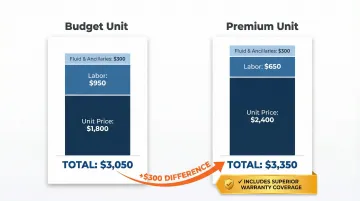
The premium unit costs $600 more upfront but only $300 more total installed — and likely includes a better warranty.
Common Mistake #2: Choosing the Cheapest Option Without Evaluating Reliability
Choosing a used transmission to save $1,000 upfront can lead to a second replacement within months, doubling the total cost.
For commercial or industrial operators, downtime has a direct revenue impact — so the "cheapest" option is rarely the lowest total cost. A $3,500 remanufactured unit with a 3-year warranty is a stronger investment than a $1,200 used unit that fails after six months and needs another $2,500 repair.
For Industrial, Hydrostatic, or Hard-to-Source Applications
The total-cost logic above applies even more sharply when your equipment is specialized. General shops often struggle to source parts for agricultural, construction, or industrial hydrostatic systems — adding lead time and unpredictable costs.
Working with a specialist who maintains an extensive OEM manufacturer database can reduce both cost and turnaround time. Hydrostatic Pump Repair focuses specifically on rebuilding and remanufacturing hydrostatic pumps and motors for these hard-to-service applications, covering equipment that most general shops decline.
Frequently Asked Questions
How much should a remanufactured transmission cost?
For standard passenger vehicles, expect $1,700–$4,200 for the unit alone, or $3,000–$7,000 total installed (including labor, fluid, and core charge). Luxury vehicles and industrial equipment can exceed $8,000–$15,000. Budget for the installed total — not just the unit price — when comparing quotes.
Is it worth buying a remanufactured transmission?
Yes, for most applications. A remanufactured transmission offers better value consistency than a used unit, with factory-level rebuild standards, comprehensive warranty coverage, and predictable lifespan. It outperforms low-quality shop rebuilds and costs significantly less than a new OEM unit.
Is it cheaper to rebuild or replace a transmission?
Shop rebuilds typically cost $1,800–$3,500, while remanufactured units cost $2,350–$4,000+. Remanufactured units often cost similar to or slightly more than a shop rebuild but offer more consistent quality and warranty protection, making them a better long-term investment.
What is the difference between a remanufactured and a rebuilt transmission?
A remanufactured transmission is disassembled at a factory level with all wear parts replaced regardless of condition (to OEM spec), while a rebuilt transmission is repaired by a local shop replacing only visibly damaged parts. That distinction — factory-controlled process versus shop-level judgment — drives the gap in warranty reliability between the two.
How long does a remanufactured transmission last?
With proper maintenance, a remanufactured transmission should provide 100,000–150,000+ miles of service, similar to a new transmission. Regular fluid changes every 30,000–60,000 miles and avoiding drivetrain overloads are the main factors in reaching the upper end of that range.
Does a remanufactured transmission come with a warranty?
Yes. Standard automotive warranties typically run 3 years/100,000 miles; commercial and industrial units usually carry 6–18 months. Confirm whether labor is included and get the full terms in writing before purchasing.