Introduction
Most Kubota operators don't think about their hydrostatic transmission (HST) until it starts failing. Unlike gear-driven systems, HST delivers infinitely adjustable speeds without clutching—critical for precision work in agriculture and landscaping. Once it degrades, the problems compound fast.
Gradual power loss leads to complete transmission failure. Speed control becomes unpredictable. Unplanned downtime costs thousands before you've even called a technician.
Ignoring early HST symptoms is expensive. Research shows unplanned equipment breakdowns cost agricultural operations an average of $3,348 per season in downtime alone. Add emergency replacement costs—often $4,500 to $7,200 for a complete HST unit—and a repairable problem becomes a major capital expense.
This guide walks you through restoring your Kubota HST: how the system works, warning signs that demand attention, service options from preventive maintenance to full rebuilds, the step-by-step rebuild process, and realistic cost and timeline guidelines.
Key Takeaways
- Catching HST warning signs early—whining, power loss, slipping—prevents catastrophic failure and saves thousands in repair costs
- Rebuild if the housing is intact and hours are moderate; replace if the case is cracked or internal damage is severe
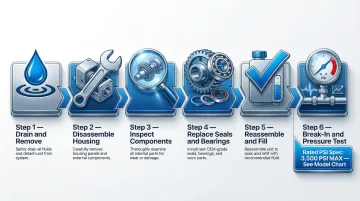
- A full rebuild follows six steps: drain fluid, disassemble, inspect components, replace seals and bearings, reassemble, and run a break-in test
- Always use Kubota Super UDT2 fluid and follow your model's torque specs precisely
Why Timely Kubota HST Rebuilds Matter
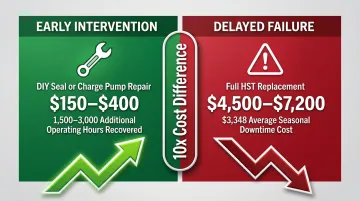
Early intervention saves money. A DIY seal replacement or charge pump repair costs $150 to $400 in parts. Wait until complete failure, and you're facing $4,500 to $7,200 for full unit replacement—roughly 10 times the cost of acting early.
Performance degradation compounds daily. A degraded HST doesn't just lose power—it creates operational chaos:
- Reduced pulling power on slopes and under load
- Inconsistent speed control that disrupts precision tasks
- Overheating under sustained use, forcing frequent shutdowns
- Downstream productivity losses for farm and landscaping operations
Those productivity losses make the rebuild case even clearer. A properly rebuilt HST can deliver an additional 1,500 to 3,000 operating hours — enough to recover years of productive service. Kubota's Limited Powertrain Warranty covers 72 months or 2,000–3,000 hours depending on series, and well-maintained units routinely push well past those thresholds. A neglected transmission, by contrast, will fail ahead of schedule no matter how sound the engine is — turning a fixable problem into a full replacement bill.
Types of Kubota HST Service
Not every HST problem requires a full rebuild. Service options exist on a spectrum, and choosing correctly depends on symptoms, operating hours, and component condition.
Preventive Maintenance and Minor Repairs
Routine fluid and filter changes are your first defense. Kubota mandates:
- First 50 hours: Change transmission fluid and replace oil filter
- Every 400 hours: Full HST fluid change and strainer cleaning
- Continuous monitoring: Fluid level checks, leak inspections, noise monitoring
Kubota HST systems require Super UDT2 transmission fluid, a proprietary formulation engineered for the system's pressure and temperature demands. Generic hydraulic or universal tractor fluids cause premature pump wear, whining, and power loss. Stick with the specified fluid and never substitute.
Full Rebuild vs. Complete Replacement
Rebuilds replace internal components—seals, bearings, charge pump, swash plate—while retaining the HST housing. Best for:
- Units with intact housings (no cracks or deep scoring)
- Light to moderate gear wear (no pitting or spalling)
- Damage limited to shaft seals or charge pump wear
Complete replacement swaps the entire HST unit. Required when:
- Housing shows cracks, deep scoring, or cavitation pitting
- Multiple major components have failed simultaneously
- Gear faces show grooves you can feel with a fingernail
For complex internal failures or hard-to-source components, professional rebuild services such as Hydrostatic Pump Repair (800-361-0028) can source parts across manufacturer lines and perform precision overhauls.
Warning Signs Your Kubota HST Needs a Rebuild
Early symptom recognition prevents full transmission failure. HST issues follow a progressive pattern—rarely sudden.
Power Loss and Speed Inconsistency
Gradual power reduction under load is the hallmark of charge pump wear or swash plate degradation. Symptoms include:
- Difficulty climbing hills that were previously manageable
- Losing speed while pulling implements
- Reduced responsiveness when accelerating
Diagnostic clues:
- Equal weakness in forward and reverse: swash plate wear
- Asymmetric performance (one direction weaker): charge pump issues
Unusual Noises During Operation
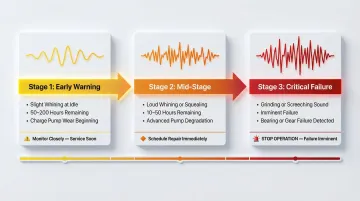
HST noise follows a predictable progression from early whining to imminent grinding:
| Stage | Noise Type | Remaining Time | Likely Cause |
|---|---|---|---|
| Early | Slight whining at idle | 50–200 hours | Charge pump wear beginning |
| Mid | Loud whining or squealing | 10–50 hours | Advanced pump degradation |
| Critical | Grinding or screeching | Imminent failure | Bearing or gear failure |
Diagnostic mapping:
- Noise stops when clutch is depressed: input bearing failure
- Noise continues with clutch depressed: countershaft bearing or charge pump
- Whining only under load: general HST component wear
Fluid Leaks and Contamination
A quick visual inspection can surface four distinct failure modes:
- Puddles or wet spots around HST housing: seal failure
- Milky fluid: water intrusion
- Gray sheen or metallic particles: internal wear, metal-on-metal contact
- Darkened or burnt-smelling fluid: overheating damage to seals and components
Overheating
Temperature thresholds determine action urgency:
| Temperature Range | Status | Action Required |
|---|---|---|
| 100–140°F (38–60°C) | Normal | Continue monitoring |
| 140–180°F (60–82°C) | Warning | Reduce load, inspect cooler |
| Above 180°F (82°C) | Critical | Shutdown immediately |
Operating consistently above 160°F reduces fluid life by 50% and accelerates seal degradation.
Chronic overheating rarely happens in isolation—it typically compounds other wear patterns, which shows up as the recurring fix cycle described below.
Recurring Failures and Temporary Fixes Not Holding
When the same fixes keep failing, the problem has moved past surface-level wear:
- Topping off fluid more frequently
- Adjusting linkages that won't stay set
- Symptoms returning with increasing frequency
Each returning symptom narrows the diagnosis: the piston block, charge pump, or swash plate has worn past the point where adjustments or fluid changes make a meaningful difference.
How to Rebuild a Kubota Hydrostatic Transmission: Step-by-Step
An HST rebuild is achievable for mechanically experienced owners. Before turning a single wrench, gather your model-specific service manual, prepare a clean workspace, and have all replacement parts on hand — mid-job parts runs often lead to reassembly errors.
Tools, Parts, and Safety Preparation
Essential tools:
- Socket and wrench set (metric)
- Bearing pullers and seal drivers
- Transmission jack
- Dial indicator
- Calibrated pressure gauge (for post-rebuild testing)
Required parts:
- Rebuild kit (seals, gaskets, bearings)
- Charge pump (if worn)
- Super UDT2 fluid (correct capacity for your model)
- New drain plug gasket
Safety steps:
- Disconnect battery
- Chock wheels
- Secure vehicle on level surface
- Wear safety glasses and gloves
With everything staged and safety measures in place, you're ready to pull the unit.
Draining Fluid and Removing the HST Unit
- Drain transmission fluid into a catch container
- Inspect drained fluid for contamination:
- Gray sheen = metal particles
- Milky appearance = water intrusion
- Photograph each connection before disconnecting (critical for reassembly)
- Disconnect driveshafts, hydraulic lines, and mounting hardware
- Remove HST unit using transmission jack
Once the unit is on the bench, work through disassembly methodically — sequence matters here.
Disassembly and Component Inspection
Disassembly sequence:
- Carefully separate HST housing
- Remove gears, bearings, seals in order
- Extract charge pump and swash plate
- Lay components in sequence for inspection
Inspection checklist:
- Pitting or scoring on pump surfaces — replace the affected components
- Cracked, hardened, or deformed seals — replace the entire seal set, not just the visible failures
- Rough-rotating or out-of-tolerance bearings — verify with dial indicator before reusing
- Blocked fluid passages — clear completely; restricted flow causes overheating after reassembly
- Gray metallic particles in the housing — confirm which surfaces shed them before ordering replacements
Replacing Components and Reassembly
Installation sequence:
- Install new seals, bearings, and gaskets from rebuild kit
- Replace charge pump or swash plate if worn
- Lubricate all moving parts with clean Super UDT2 fluid before assembly
- Follow service manual torque specifications precisely—over-torquing causes housing cracks; under-torquing causes leaks
Reinstalling, Filling, and Break-In Testing
Reinstallation:
- Reinstall HST unit using transmission jack
- Reconnect all lines and linkages (reference photos)
- Fill with correct volume of Super UDT2 fluid (check model specifications)
Break-in and air bleeding procedure:
- Place tractor's rear axle on jack stands (wheels off floor)
- Start engine at low idle
- Repeat opening/closing bypass valve while shifting forward/reverse
- After axle shafts start rotating, lower rear wheels
- While stroking HST lever forward, push vehicle backwards; when stroking reverse, push forward
- When vehicle starts moving, increase to high idle and repeat quick starts/stops until full response achieved
Pressure testing:
- Heat fluid to 50°C (122°F) with engine at maximum RPM
- Verify pressure is within spec range for your model:
| Tractor Series | High-Pressure Relief Spec |
|---|---|
| BX Series (BX1880/2380/2680) | 1,790–1,850 PSI |
| B Series (e.g., B7200HST) | 1,991 PSI |
| L Series (L3301/L3901/L4701) | 2,349–2,560 PSI |
Listen for abnormal noise and check for leaks during the first 30 minutes of operation.
Common Rebuild Mistakes to Avoid
- Using incorrect or mixed fluid types accelerates pump wear — Super UDT2 is not interchangeable with standard hydraulic fluid
- Over- or under-torquing fasteners creates leaks or cracks the housing — always use a calibrated torque wrench
- Skipping the break-in procedure leaves air pockets that cause cavitation damage within hours of operation
- Replacing only the visible failed seals — the rest will follow within weeks; replace the full set
- Neglecting the HST cooler and screens pushes contamination right back into a freshly rebuilt unit
Kubota HST Rebuild Cost and Service Schedule
Rebuild costs and timing depend on tractor model, operating hours, internal damage extent, and whether work is DIY or professional. The ranges below reflect real-world variation across the Kubota BX, B, and L series — use them as a planning baseline, not a fixed quote.
Rebuild Cost Breakdown
| Repair Type | Labor Hours | Parts Cost | Total Cost Range |
|---|---|---|---|
| DIY Rebuild (Light Wear) | N/A | $100–$300 | $150–$400 |
| HST Charge Pump (Professional) | 6–10 hours | $300–$800 | $800–$2,000 |
| Bearing Replacement (Professional) | 14–18 hours | $200–$800 | $1,700–$3,400 |
| Complete Rebuild (Professional) | 20–30 hours | $1,500–$3,000 | $3,200–$7,000 |
| Complete HST Unit Replacement | 16–24 hours | $2,500–$4,200 | $4,500–$7,200 |
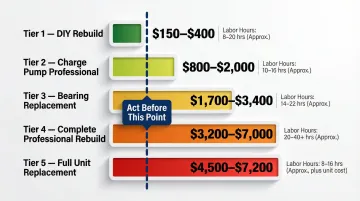
Cost varies significantly between BX/B series (smaller, less expensive) and L series (larger, higher component costs).
Rebuild vs. Replace Decision Factors
Choose rebuild when:
- HST housing is intact (no cracks or deep scoring)
- Pressure readings are recoverable with component replacement
- Tractor hours are moderate (under ~2,000–3,000 hours)
- Failure is limited to seals, bearings, or charge pump
Choose replacement when:
- Housing is cracked or deeply scored
- Multiple major components have failed
- Tractor has very high hours, making rebuild ROI questionable
- Gear faces show deep cavitation pitting
Kubota HST Service Schedule (General Guidelines)
Once you've decided to rebuild or replace, consistent maintenance is what prevents the next failure. High-use or continuous-operation environments warrant more frequent intervals than light residential use.
| Interval | Service Tasks |
|---|---|
| Every 50 hours | Fluid level check, leak inspection, noise monitoring (critical for new or post-rebuild units) |
| Every 400 hours | Full HST fluid and filter change |
| Every 800–1,000 hours | Comprehensive inspection, pressure test, cooler cleaning |
| Annual or high-hour | Overhaul consideration based on symptoms and pressure testing |
Conclusion
A Kubota HST rebuild—done at the right time with the right parts—is one of the most cost-effective ways to restore full performance and extend equipment life. The gap between a $400 early intervention and a $7,000 emergency replacement comes down to catching warning signs before they escalate.
Whether you tackle the rebuild yourself or hand it to a professional, following a structured process and adhering to post-rebuild maintenance intervals keeps your machine out of the shop and productive for thousands of additional hours.
Frequently Asked Questions
Is it worth rebuilding a transmission or replacing it?
Rebuilding is generally worth it when internal damage is contained, the housing is intact, and tractor hours are moderate. Full replacement becomes the better value when multiple major components have failed, the housing is cracked, or operating hours are very high.
What is the average cost to fix a transmission?
Typical costs break down as follows: $800–$2,000 for minor repairs (such as charge pump replacement), $3,200–$7,000 for a full professional HST rebuild, and $4,500–$7,200 for complete unit replacement. Labor rates and tractor model — BX vs. L series — significantly affect where you land in those ranges.
How long will a hydrostatic transmission last?
A properly maintained Kubota HST can last 2,000 to 4,000+ hours. Changing fluid every 400 hours and catching symptoms early are the two biggest factors in how long your HST lasts. Sustained operation above 180°F drastically reduces lifespan.
What kind of transmission does a Kubota have?
Kubota equipment uses hydrostatic (HST), gear-drive, or CVT transmissions depending on the model. Most BX, B, and L series tractors use HST for its smooth, variable-speed operation — no clutching required.
What fluid does a Kubota hydrostatic transmission use?
Kubota HST systems require Super UDT2 (or an exact approved equivalent meeting Kubota specifications). Using generic hydraulic or universal tractor fluid causes premature pump wear, whining, and power loss. Never mix brands.
Can I rebuild a Kubota hydrostatic transmission myself?
Experienced DIY mechanics with the right tools and model-specific service manual can perform a rebuild. However, complex failures or precision pressure adjustments require specialized tools — bearing pullers, dial indicators, and pressure gauges — and those jobs are best left to a professional.