Introduction
An excavator's ability to navigate job sites, cross rough terrain, and reposition between work areas depends on one component that rarely gets attention: the hydraulic travel motor. Without it, even the most powerful excavator sits dead in the water—unable to move, turn, or travel.
This guide covers how travel motors work, what separates them from final drives, how two-speed systems control machine movement, and what failure looks like before it becomes a costly breakdown.
Key Takeaways
- Hydraulic travel motors convert pressurized hydraulic fluid into rotational force that drives excavator tracks
- Each excavator has two independent travel motors—one per track—enabling precise steering and pivot turns
- Travel motors sit inside the final drive assembly — related components, but not interchangeable terms
- Most modern excavators use axial piston motors with two-speed capability to balance torque and speed
What Is a Hydraulic Travel Motor on an Excavator?
A hydraulic travel motor is a specialized hydraulic motor that converts pressurized fluid from the excavator's hydraulic pump into rotational mechanical motion, which drives the machine's undercarriage tracks. Also called a track motor or drive motor, this component serves as the primary power source for excavator mobility.
Location and Configuration
Travel motors are located at the rear of each undercarriage track—one motor per track. This dual-motor configuration provides independent control over each track's speed and direction, enabling:
- Smooth turning by running one track faster than the other
- Pivot turns (counter-rotation) where one track moves forward while the other reverses
- Precise maneuverability without moving the upper structure
That independent control depends entirely on each motor doing its job in sequence. Here's where the travel motor fits in the excavator's mobility chain:
Role in the Drivetrain
Hydraulic pump → Control valve → Travel motor → Final drive gearbox → Sprocket → Tracks
Without a functioning travel motor, the excavator has zero mobility regardless of how well other systems operate. The motor receives high-pressure hydraulic fluid from the pump and converts that pressure into rotational energy. That torque then passes through the gearbox to turn the sprocket and drive the tracks.
Terminology Clarification
The terms "travel motor," "track motor," and "drive motor" all refer to the same hydraulic component. Confusion arises with "final drive" because the complete final drive assembly packages the travel motor together with the planetary gearbox. The travel motor refers specifically to the hydraulic unit itself. The final drive encompasses both the motor and gearbox as a complete assembly. Keeping that distinction straight when ordering parts or requesting service prevents misquotes and delays.
Key Components of a Hydraulic Travel Motor
Hydraulic Motor Core (Piston Assembly)
The piston assembly consists of multiple pistons arranged around a rotating cylinder barrel. This is where energy conversion occurs: pressurized hydraulic fluid acts on the pistons, forcing them to reciprocate and generate rotational force. The cylinder barrel rotates as the pistons cycle, converting hydraulic pressure into mechanical rotation.
Swash Plate
The swash plate is an angled disc against which the pistons push as they cycle. The angle of this plate determines how far each piston strokes per revolution, directly controlling:
- Motor displacement (volume of fluid required per rotation)
- Torque output (pushing force)
- Rotational speed
Modern two-speed excavators use variable-angle swash plates to shift between high-torque/low-speed and low-torque/high-speed modes, balancing power and travel efficiency depending on terrain demands.
Travel Gearbox (Planetary Gear System)
After the hydraulic motor produces rotation, the planetary gearbox multiplies torque before transmitting it to the sprocket. Planetary gears deliver high torque in a small footprint, which matters given the tight space inside the undercarriage. Without this gear reduction stage, the motor spins too fast with insufficient torque to move heavy tracks.
Motor Housing
The housing is the structural shell that contains all internal components, protects them from external contamination (mud, debris, water), and maintains the sealed hydraulic environment necessary for pressure buildup. Housing integrity is critical: cracks or warping lead directly to leaks and pressure loss.
Seals and Case Drain Line
Seals prevent hydraulic fluid from escaping the motor internally and externally. The case drain line routes bypass fluid—fluid that intentionally leaks past internal components to lubricate them—back to the hydraulic tank.
A blocked or restricted case drain is one of the most common causes of travel motor failure. Consequences include:
- Catastrophic internal pressure buildup
- Blown seals
- Piston damage
How a Hydraulic Travel Motor Works
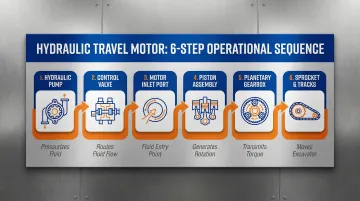
Operational Sequence
The travel motor operates through a well-coordinated sequence:
- Hydraulic pump pressurizes fluid based on engine speed and system demand
- Operator's travel controls signal the control valve to route pressurized fluid to the appropriate travel motor
- Fluid enters the motor through the high-pressure port and acts on the piston assembly
- Pistons push against the swash plate, generating rotational force on the output shaft
- Rotating output shaft transmits torque through the planetary gearbox to the sprocket
- Sprocket drives the tracks, moving the excavator
Two-Speed System Operation
Most excavators feature "turtle" (low-speed, high-torque) and "rabbit" (high-speed, lower-torque) travel modes. The system works by changing the swash plate angle:
Low Speed / High Torque Mode:
- Swash plate remains at a steep angle
- Pistons stroke through a long distance per revolution
- Motor requires full hydraulic flow to complete each rotation
- Maximum torque for climbing, digging, or working on slopes
High Speed / Low Torque Mode:
- Pilot pressure signal activates an internal piston
- Piston pushes swash plate to a shallower angle
- Shorter piston strokes reduce displacement
- Motor spins faster for the same hydraulic flow input
- Ideal for traveling between work areas on level ground
When the high-speed signal is removed, a return spring pushes the swash plate back to full displacement, restoring maximum torque.
Directional Control
The control valve determines which port receives high-pressure fluid and which returns it to the tank. Reversing this flow direction reverses the motor's rotation, driving the track backward. Because each track's motor is independently controlled, operators achieve steering, turning, and counter-rotation by varying the speed and direction of each motor.
Performance Relationship: Flow, Pressure, and Movement
- Higher hydraulic flow produces faster track speed
- Higher pressure produces more torque (pushing force)
- A weak or worn hydraulic pump reduces both available speed and tractive effort
Travel performance problems don't always point to the motor. A degraded pump or compromised valve can rob the entire system of speed and pulling force, so hydraulic health needs to be evaluated as a whole.
Travel Motor vs. Final Drive: Key Differences
What Is the Final Drive?
The final drive is the complete assembly that includes both the hydraulic travel motor and the planetary gearbox. When someone refers to a "final drive failure," it could mean the hydraulic motor portion, the gearbox portion, or both components have failed.
Functional Distinction
| Component | Function |
|---|---|
| Travel Motor | Energy conversion: hydraulic pressure → mechanical rotation |
| Planetary Gearbox | Torque multiplication and speed reduction before output to sprocket |
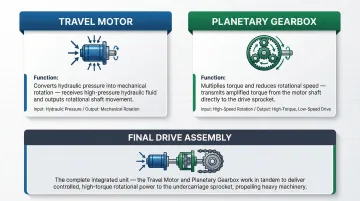
Neither component alone is sufficient. The motor produces rotation but at too high a speed and too little torque to drive heavy tracks without the gearbox stage.
Identification and Ordering Parts
The final drive motor is the full bolted assembly visible on the undercarriage. The travel (hydraulic) motor is the cylindrical hydraulic unit attached to the back of the final drive assembly. When ordering replacement parts or requesting repair services, using precise terminology and providing the machine's serial number prevents ordering the wrong component — especially important given the price and lead time involved.
Types of Hydraulic Travel Motors Used in Excavators
Axial Piston Motors
Axial piston motors are the dominant design in modern mini, midi, and full-size excavators. Key characteristics include:
- Pistons run parallel to the output shaft around a rotating cylinder barrel
- High efficiency, compact dimensions, and variable displacement capability
- Standard across excavators from 1.5-ton to 50-ton+ machines
- Enable two-speed swash plate mechanisms, balancing torque and speed range effectively
Their compact form factor is what makes them practical — excavator undercarriages leave little room to spare, and axial piston designs fit where bulkier alternatives won't. Radial piston motors take a different approach entirely.
Radial Piston Motors
Radial piston motors feature pistons arranged radially (like spokes on a wheel) perpendicular to the output shaft. Characteristics include:
- Deliver higher torque at lower speeds than axial designs
- Found on larger, heavier machines where extreme pulling force outweighs speed range requirements
- Produce exceptional low-speed, high-torque (LSHT) output without extensive gear reduction
- Bulkier and heavier, with limited suitability for variable displacement configurations
Which Type Is Best for Excavators?
For most excavator applications—especially compact to mid-size machines—the axial piston motor with variable displacement is the preferred choice. Radial piston designs are relegated to specialized, very large equipment where extreme torque demands justify the added size and weight. Match motor specification to the machine's weight class and the work it does — a 5-ton compact excavator and a 50-ton mining machine have very different demands, and the motor type should reflect that.
Maintenance Tips and When to Get Professional Help
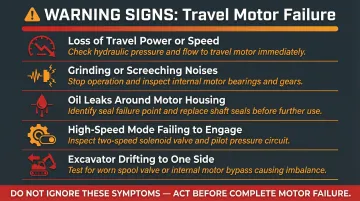
Warning Signs of Travel Motor Problems
Catching symptoms early prevents a repairable motor from becoming a full replacement. Watch for:
- Loss of travel power or speed on one or both tracks
- Grinding or screeching noises from the undercarriage during movement
- Oil leaks around the motor housing or case drain line
- High-speed mode failing to engage or disengage properly
- Excavator drifting or pulling to one side during straight-line travel
Essential Routine Maintenance
Fluid and filters:
- Check hydraulic fluid level and quality regularly
- Monitor case drain filter for restriction—a blocked case drain causes catastrophic pressure buildup
- Change final drive gear oil every 500–1,000 hours or per manufacturer schedule
Physical inspection:
- Inspect travel motor seals and fittings for leaks at each service interval
- Keep the undercarriage clear of packed mud and debris that trap heat or push contaminants into seals
- Check for unusual heat buildup around the motor housing
- Increase inspection frequency in harsh conditions (mud, sand, high heat)
- Monitor gear oil for metal flakes—fine dust is normal; large flakes require immediate action
When Professional Repair Is Required
Internal damage to the piston assembly, swash plate, or planetary gears requires specialized tooling and expertise beyond routine maintenance. When symptoms persist after addressing fluid levels and external leaks, the motor needs to be disassembled, inspected, and rebuilt by a qualified hydraulic repair technician.
Hydrostatic Pump Repair rebuilds hydraulic travel motors to OEM specifications for a wide range of excavator brands—including hard-to-source manufacturers such as Case, Koehring, and Linde. For service inquiries or technical support, call 800-361-0028.
Frequently Asked Questions
What are the components of a travel motor?
The main components include the hydraulic piston assembly (cylinder barrel and pistons), swash plate, output shaft, travel gearbox (planetary gear set), motor housing, seals, and case drain line. Together, these parts convert hydraulic pressure into the track rotation that moves the machine.
What is the difference between final drive and travel motor?
The travel motor is the hydraulic unit that converts fluid pressure into rotation. The final drive is the complete assembly that includes both the travel motor and the planetary gearbox, which multiplies torque before it reaches the sprocket and tracks.
Which type of motor is best suited for the excavator?
Axial piston motors are the standard choice for most excavator sizes — they balance efficiency, compact design, and variable displacement for two-speed operation. Radial piston motors suit larger machines where high torque output takes priority.
How do I know if my excavator travel motor is failing?
Common warning signs include:
- Loss of travel power or the machine pulling to one side
- Grinding or squealing from the undercarriage
- Visible oil leaks around the motor
- Inability to engage or hold high-speed mode
How often should a hydraulic travel motor be serviced?
Inspect the travel motor and check gear oil every 250–500 hours of operation (or per manufacturer schedule), with a full gear oil change at recommended intervals. Check more frequently in muddy, sandy, or high-heat conditions.
Can a hydraulic travel motor be repaired, or does it need full replacement?
Travel motors can often be rebuilt through seal replacement, piston reconditioning, or swash plate repair — provided the housing is intact and damage is caught early. Full replacement is needed when the housing is cracked or internal wear is too extensive to restore.