Introduction
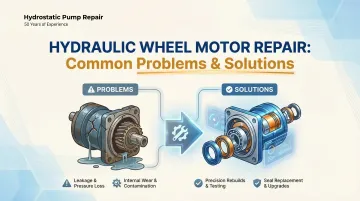
When a hydraulic wheel motor fails mid-harvest or mid-project, the entire operation stops. A cotton picker sidelined during peak season or an excavator down at a job site means lost productivity, missed deadlines, and repair bills that compound fast. These motors are the core drive components in excavators, skid steers, agricultural machinery, and mobile industrial platforms — and downtime is never cheap.
Most failures, though, follow predictable patterns. Fluid leaks, power loss, overheating, and abnormal noises all point to specific underlying causes — and catching them early makes the difference between a straightforward repair and a full motor replacement. This guide covers the most common hydraulic wheel motor problems, how to diagnose them correctly, and when professional rebuilding is the smarter call.
Key Takeaways
- Most failures stem from fluid leaks, power loss, overheating, or abnormal noises—each with identifiable causes
- Early intervention prevents costly damage; severe internal wear may require full rebuild or replacement
- Diagnosing root cause before starting repairs is critical; treating symptoms alone guarantees repeat failures
- Professional rebuild services are essential when internal components like pistons, bearings, or valve plates are damaged and OEM-spec parts are needed
What Is a Hydraulic Wheel Motor?
A hydraulic wheel motor is a rotary actuator that converts pressurized hydraulic fluid into mechanical torque and wheel rotation. Unlike hydraulic cylinders that produce linear motion, wheel motors deliver continuous rotational drive directly to wheels or rollers, making them ideal for mobile and heavy equipment applications.
Pressurized fluid enters the motor and acts on internal pistons or rotors, generating shaft rotation that drives the wheel. The mounting flange sits near the motor's center, allowing part or all of the motor to be housed inside the wheel or roller hub — placing the load directly over the bearings for longer service life under heavy use.
Three designs cover most applications:
- Radial piston motors – Heavy-duty use (tracked vehicles, forklifts); up to 470 bar (6,816 psi) and 8,530 Nm torque
- Gerotor/orbital motors – Compact, low-speed/high-torque solutions (material handling, sweepers); up to 310 bar (4,500 psi)
- Axial piston motors – Track drives and excavators; peak pressure 430 bar (6,236 psi)
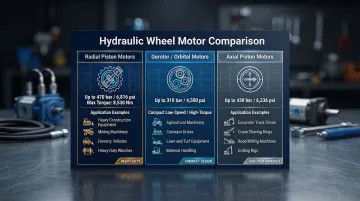
Because these motors run under continuous load and high cycle counts, they're prone to specific failure patterns — wear, contamination, seal fatigue, and pressure imbalances — that show up in predictable ways. Understanding those patterns is the first step to diagnosing and fixing them.
Common Problems With Hydraulic Wheel Motors
Hydraulic wheel motor failures tend to show up the same way across equipment types — and knowing what to look for makes the difference between a quick fix and a full rebuild.
Problem 1: Hydraulic Fluid Leaks
Symptoms:
- Visible oil pooling under equipment
- Wet or oily residue on motor housing or hose connections
- Gradual drop in system fluid level
Likely Cause:
- Degraded O-rings or shaft seals from age, heat cycles, or overpressure
- Excessive case drain back-pressure — when case pressure exceeds ~25 psi, it forces outward on the shaft and blows seals within minutes
- Loose hydraulic fittings loosened by vibration over time
Problem 2: Loss of Power or Torque
Symptoms:
- Wheel turns slower than expected
- Machine struggles under load
- Uneven drive between motors on multi-motor systems
Likely Cause:
- Internal wear on pistons, valve plates, or rotor/stator surfaces, allowing fluid to bypass from high-pressure to low-pressure chambers
- Internal leakage that cuts mechanical output even when system pressure reads normal
- Clogged filters restricting flow or incorrect system pressure settings
Problem 3: Overheating
Symptoms:
- Unusually hot motor housing to the touch
- Heat warnings on system gauges
- Fluid discoloration or burnt smell
- Accelerated seal degradation
Likely Cause:
- Low fluid level or clogged filters creating excessive back-pressure
- Fluid viscosity outside the motor's specified range
- Motor operating beyond its rated load or duty cycle — heat then degrades seals and breaks down fluid, compounding the damage
Problem 4: Abnormal Noises
Symptoms:
- Persistent grinding or metallic knocking during operation
- High-pitched whining at startup or under load
- Irregular noise changes with speed or direction
Likely Cause:
- Worn or failing bearings
- Cavitation from air ingestion or insufficient fluid supply
- Damaged internal components — pistons, valve plate, or distributor
- Contaminated fluid carrying abrasive particles that score precision surfaces
Why Hydraulic Wheel Motors Fail: Root Causes
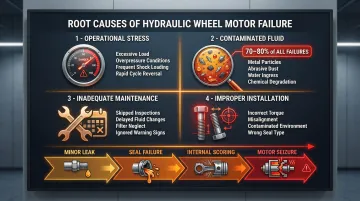
Hydraulic wheel motor failures trace back to four real-world conditions:
1. Operational stress – Running motors beyond rated pressure, speed, or load shortens service life dramatically. Exceeding maximum intermittent pressures requires factory approval and reduces expected lifespan.
2. Contaminated hydraulic fluid – Industry research consistently shows that 70% to 80% of all hydraulic system failures are directly caused by fluid contamination. Particulates, water ingress, or wrong viscosity grades accelerate wear.
3. Inadequate maintenance – Skipped fluid changes, neglected filter replacements, and unaddressed minor leaks allow small problems to compound into major failures.
4. Improper installation – Incorrect port connections, inadequate case drain plumbing, or misaligned mounting create stress points that lead to premature component failure.
The Cost of Ignoring Early Warning Signs
Progressive internal wear accelerates when early symptoms are ignored. A minor seal leak becomes complete motor seizure. Contaminated fluid from a failing motor damages pumps and valves throughout the system. What could have been a manageable seal replacement becomes an emergency rebuild or full replacement—during peak operating season when downtime costs are highest.
Fluid contamination is the most destructive of these failure paths, and the reason comes down to physics. Clearances inside hydraulic motors are extremely tight — fluid film thickness in rolling bearings measures just 0.1 to 1 µm; in valve assemblies, 1 to 4 µm. Particles at or above these sizes make simultaneous contact with opposing surfaces, concentrating loads into microscopic areas. The damage this causes depends on contact type:
- Sliding contacts (valve faces, seal surfaces): abrasive gouging that widens clearances and kills volumetric efficiency
- Rolling contacts (bearings, gear teeth): fatigue spalling that creates pitting and accelerates bearing failure
Once this damage begins, it's irreversible without a rebuild.
How to Fix a Hydraulic Wheel Motor: Step-by-Step
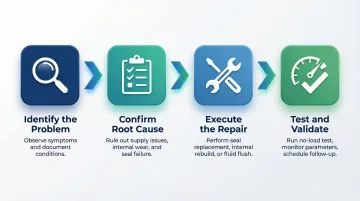
Every repair in this guide follows the same sequence: diagnose first, then fix. Skipping diagnosis leads to wasted parts and repeat failures.
Step 1: Identify the Exact Problem
- Observe all visible symptoms: fluid leaks (location and volume), unusual sounds, vibration, output speed deviations, overheating indicators
- Document when and under what conditions the problem occurs—at startup, under load, continuously, or only in one direction
- This documentation narrows the failure category significantly and prevents misdiagnosis
Step 2: Confirm the Root Cause Category
Determine whether the failure is primarily:
- Fluid or system supply — low flow, incorrect pressure, or contamination upstream of the motor
- Internal mechanical wear — pistons, barrel/rotor, valve plate, or bearings
- Seal or leak failure — shaft seals, O-rings, or fittings
Rule out external system factors first:
- Verify hydraulic pump output pressure and flow rate
- Check filter condition and differential pressure
- Inspect fluid level and quality
- Test case drain back-pressure
Many apparent motor failures actually originate in the supply system. Confirming the motor itself is the problem—rather than upstream components—saves time and prevents unnecessary disassembly.
Step 3: Execute the Repair Based on Confirmed Cause
Follow the path that matches your confirmed root cause. Each scenario requires a different approach.
If the Motor Has a Seal or Leak Issue
- Safely depressurize the circuit and remove the motor
- Disassemble to access shaft seals and O-ring sets
- Replace all seals with manufacturer-spec parts, not generic substitutes
- Inspect seal contact surfaces for scoring before reassembly. Scored shafts or bores need refurbishment or replacement before new seals will hold.
- For motors from less common manufacturers, Hydrostatic Pump Repair specializes in rebuilding units that are difficult to source rebuild support for elsewhere
If the Motor Has Internal Mechanical Wear
- Disassemble the motor and inspect pistons, barrel/rotor, valve plate, and bearings for scoring, pitting, or dimensional wear beyond tolerance
- Replace worn components as a matched set where required. Mixing old and new precision parts creates uneven wear patterns and shortens service life.
- Clean all internal surfaces thoroughly before reassembly to remove any contamination
- Torque fasteners to specification per manufacturer guidelines
If the Issue Is Fluid or System-Related
- Drain and flush contaminated fluid from the entire circuit, not just the motor
- Replace all hydraulic filters to prevent recontamination
- Refill with manufacturer-specified fluid grade and viscosity
- Bleed air from the system if cavitation was present
- Verify pump output pressure and flow at the motor inlet before restarting
Step 4: Test and Validate the Repair
- Run the motor under no-load conditions first, then gradually apply normal operating load
- Monitor for recurrence of the original symptom (noise, heat, leak, output loss)
- Confirm pressure readings, output speed, and case drain flow are within normal operating parameters
- Document the repair and schedule a follow-up inspection within the first 50–100 operating hours to catch any developing issues early
When Should You Fix vs. Replace a Hydraulic Wheel Motor?
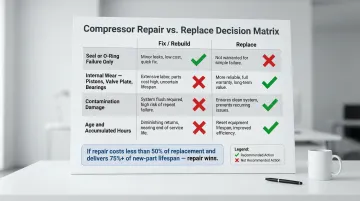
The fix-or-replace decision depends on the extent of internal damage, parts availability, repair cost relative to replacement cost, and the motor's remaining service life.
Scenario 1: Seal or O-Ring Failure Only
Fix: Replace seals—relatively low cost and straightforward repair with no internal wear present.
Replace: Only if seal failure was caused by a deeply scored shaft or housing bore that cannot be refurbished.
Scenario 2: Internal Wear (Pistons, Valve Plate, Bearings)
Fix/Rebuild: If motor housing and major castings are intact, a professional rebuild restoring internal components to spec is often the better financial choice. Industry guidance suggests that if repair costs less than 50% of replacement cost and delivers at least 75% of new-part lifespan, repair is the profitable choice.
Replace: If multiple components are severely worn beyond tolerance or rebuild cost exceeds 50% of a new/remanufactured unit price, replacement is the better call.
Scenario 3: Contamination Damage
Fix: If caught early with limited particle scoring, flush the system, replace fluid and filters, and refurbish affected surfaces.
Replace: If abrasive contamination has caused widespread scoring across pistons, bore, and valve plate, the damage typically extends beyond what machining can restore to tolerance—rebuilding won't recover full performance.
Scenario 4: Age and Accumulated Hours
Fix: If the motor is otherwise in good mechanical condition with isolated wear on serviceable parts.
Replace: If the motor has exceeded its typical service life expectancy and multiple components are approaching end-of-life simultaneously. OEMs calculate service life using B10 bearing life ratings—for example, Danfoss orbital motors are rated for 2,000 hours (or 12,000,000 shaft revolutions) at 100 RPM at rated torque. When motors reach or exceed these thresholds with multiple worn components, replacement is often more economical than piecemeal repairs.
When a rebuild is the right call, Hydrostatic Pump Repair specializes in returning hydraulic wheel motors to OEM specifications—covering major brands and hard-to-find manufacturers alike.
Common Mistakes to Avoid When Repairing a Hydraulic Wheel Motor
Fix the root cause, not just the symptom. Replacing seals on a motor that's overpressurized due to a downstream blockage leads to immediate repeat failure — the new seals blow out just as fast as the originals.
Always verify before returning to service. Running a motor back into operation without confirming pressure, flow, and case drain parameters misses reassembly errors. Testing under controlled conditions catches problems before they cause secondary failures.
Match parts to manufacturer specifications. O-ring materials, seal hardness ratings, and dimensional tolerances must align with OEM specs. Generic substitutes fail prematurely under hydraulic pressure and temperature cycling.
Flush the entire circuit after a motor failure. A failed motor contaminating the fluid with metal particles will destroy a freshly rebuilt unit within hours if the circuit isn't fully flushed and filters replaced. The motor is one component — the system is the job.
Preventive Measures to Avoid Future Issues
Proactive maintenance consistently delivers a lower total cost of ownership than reactive repair — and the majority of hydraulic wheel motor failures are entirely avoidable with the right habits in place.
Scheduled Fluid and Filter Maintenance
Follow manufacturer-specified intervals for hydraulic fluid changes and filter replacement. Rather than relying on arbitrary time intervals, implement condition-based monitoring through routine oil sampling. Oil analysis detects wear metals and contamination before failure occurs, establishing wear rate trends that predict remaining service life.
Target fluid cleanliness levels: Modern hydraulic motors require extremely clean fluid. For radial piston motors like the Bosch Rexroth MCR series, maintain ISO 4406 cleanliness of 20/18/15 or better. A single step deterioration in ISO cleanliness class doubles particle concentration and sharply reduces service life.
Regular Visual and Performance Inspections
- Check for early-stage leaks at seals and fittings before they become major fluid loss
- Monitor case drain flow rate as an indicator of internal wear—increasing case drain flow signals growing internal leakage
- Track output speed consistency across operating cycles
- Document baseline performance to detect gradual degradation that might otherwise go unnoticed
Correct Operating Practices
- Stay within rated pressure and speed limits — sustained overload accelerates wear on every internal component
- Allow adequate warm-up time in cold conditions (typically 5–10 minutes at low load) to prevent cavitation from cold, viscous fluid
- Verify that case drain lines are always properly connected and free-flowing before operating—blocked case drains destroy shaft seals almost immediately
- Never exceed maximum intermittent pressure ratings without factory approval
Conclusion
Most hydraulic wheel motor problems—leaks, power loss, overheating, and noise—follow identifiable patterns and are repairable when caught early. The difference between a simple seal replacement and a complete motor replacement often comes down to how quickly you recognize and respond to early warning signs.
Getting the root cause right determines whether your repair actually holds. Knowing when a repair is viable versus when a rebuild or replacement is the smarter investment prevents both under-spending (repeated failures from inadequate repairs) and over-spending (replacing motors that could have been rebuilt cost-effectively).
When the diagnosis isn't clear-cut, rebuild specialists like Hydrostatic Pump Repair can assess the damage, compare costs accurately, and source OEM-spec components for even hard-to-find manufacturers. Reach them at 800-361-0028.
Frequently Asked Questions
Can hydraulic wheel motors be repaired?
Yes, most hydraulic wheel motors can be repaired or rebuilt. Seal failures, minor internal wear, and contamination damage caught early are good candidates for rebuilding. Professional rebuild services restore motors to OEM specifications, often at a fraction of replacement cost, though severely damaged internal components may require full replacement.
How can I tell if a hydraulic wheel motor is bad?
Key warning signs include visible fluid leaks around seals or fittings, loss of drive power or torque under load, overheating (unusually hot housing or burnt fluid smell), and abnormal grinding or whining noises during operation. Any combination of these symptoms indicates the motor requires immediate inspection.
Why won't my hydraulic wheel motor spin?
The most likely causes are insufficient hydraulic pressure or flow from the pump, a seized internal component (bearing or piston), a failed valve plate preventing fluid distribution, or a blocked case drain line creating back-pressure that prevents rotation. Start diagnosis by verifying pump output and case drain flow.
What causes a hydraulic wheel motor to fail?
Primary root causes include contaminated hydraulic fluid (responsible for 70-80% of failures), seal and O-ring degradation from age or overpressure, operating beyond rated load or pressure, and deferred maintenance leading to accelerated internal wear. Improper case drain plumbing also destroys shaft seals rapidly.
What is the life expectancy of a hydraulic wheel motor?
Life expectancy depends on application and maintenance quality. Heavy-duty orbital motors are typically rated around 2,000 hours at rated torque using OEM B10 bearing life calculations. Well-maintained motors in light-duty applications can exceed 5,000 hours; severe-duty or poorly maintained units may fail under 1,000 hours.
How much does it cost to rebuild a hydraulic wheel motor?
As a benchmark, if rebuild costs exceed 50% of a new or remanufactured unit price, replacement is usually more economical. Simple seal replacements typically run a few hundred dollars; complete rebuilds with internal component replacement can reach several thousand, depending on motor size and damage extent.