Introduction
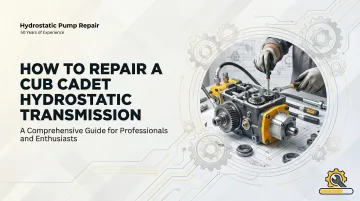
A Cub Cadet that creeps at full throttle, surges unpredictably, or loses drive in one direction almost always points to the hydrostatic transmission. Most owners assume the worst, but the reality is more encouraging: the majority of these failures trace back to fixable issues like low fluid, trapped air, or misaligned control linkage — not a seized pump or failed motor.
This guide walks through common hydrostatic transmission symptoms, step-by-step diagnostic and repair methods, and practical advice on when a rebuild or replacement makes more sense than continued troubleshooting. By the end, you'll know exactly where your transmission stands — and what to do about it.
Key Takeaways
- Low fluid, trapped air, and control linkage misalignment cause most drive problems
- Check fluid level, purge air, and adjust neutral setting before assuming internal failure
- Trunnion wear and seal failure require partial disassembly or professional rebuild
- Catastrophic damage typically makes replacement more cost-effective than repair
- Never tow a hydrostatic tractor—it causes severe internal damage
What Is a Cub Cadet Hydrostatic Transmission?
A hydrostatic transmission is a closed-loop hydraulic system that uses pressurized fluid—rather than mechanical gears—to transfer engine power to the wheels. This design enables infinitely variable speed control without shifting, a practical advantage for lawn tractors that need precise ground speed in tight spaces.
Most Cub Cadet models use integrated hydrostatic transaxles (IHTs) from manufacturers like Tuff Torq (K46 units in XT1/XT2 series) or Hydro-Gear (ZT-2100/ZT-2200 in zero-turn models). Older heavy-duty garden tractors often feature Sundstrand 15 Series pumps paired with gear drives.
Regardless of model, most units share the same core components:
- Variable displacement axial piston pump
- Fixed displacement hydraulic motor
- Fluid reservoir and filter
- Control linkage and swashplate mechanism
- Seals, valves, and charge pump
The system requires clean fluid, proper pressurization, and correctly calibrated controls. Even minor issues in one component (a clogged filter or worn seal, for example) can degrade the entire drive system's performance.
Common Cub Cadet Hydrostatic Transmission Problems
Most failures follow recognizable patterns. Matching the right symptom to the right cause saves you time, money, and the risk of replacing parts that don't need it.
Tractor "Creeps" or Rolls in Neutral
Symptoms: Tractor slowly moves forward or backward with the control lever in neutral, especially at high idle.
Likely cause: Transmission control rod misalignment or worn linkage. The external control mechanism no longer holds the neutral position accurately. In most cases, adjusting or replacing the Return-to-Neutral (RTN) linkage resolves this without touching the transmission itself.
Tractor Won't Move or Has No Drive Power
Symptoms: Engine runs normally but tractor fails to move in forward or reverse, or responds sluggishly from a stop.
Likely causes:
- Low or contaminated hydraulic fluid
- Air trapped in the system (cavitation)
- Slipping drive belt
- Disconnected or slipping control linkage
Rule these out before assuming internal transmission failure.
Loss of Power on Slopes or Under Load
Symptoms: Tractor slows dramatically or stops when climbing inclines. Performance typically degrades as the unit warms up, a sign the system is losing pressure under load.
Likely causes:
- Internal wear in pump or motor (loss of hydraulic pressure under load)
- Partially slipping traction drive belt
- Oil thinning from overheating
If fluid and belt checks come back clean, worn pump or motor internals are the likely culprit — and the unit may need professional rebuild or replacement.
Transmission Overheating
Symptoms: Hot smell from transmission area, fluid discoloration, performance degrading after 20-30 minutes of use.
Likely causes:
- Low fluid level
- Clogged hydraulic filter
- Incorrect fluid type breaking down under operating temperatures
- Debris packed around cooling fins, blocking heat dissipation
Unusual Noises (Whining, Grinding, or Cavitation)
Symptoms: High-pitched whine, grinding, or rapid chattering sound from the transmission during operation.
Likely causes:
- Air ingestion (cavitation) from low fluid
- Pump starvation from clogged filter
- Worn internal components (trunion mechanism, bearings, valve plates)
How to Repair a Cub Cadet Hydrostatic Transmission
Jumping to component replacement without structured diagnosis wastes time and money. Start with the simplest, most common causes and work inward toward the transmission itself only after ruling out external factors.
Step 1: Check Fluid Level, Condition, and Type
Consult your model-specific manual to locate the hydrostatic fluid reservoir. On many Tuff Torq K46 units, the fill port sits under the fan and pulley. Low fluid is the first thing to check — it's one of the most overlooked causes of sluggish performance.
Inspect the fluid condition before adding anything:
- Dark or milky fluid indicates contamination or internal breakdown
- Gritty texture means wear particles are circulating through the system
- Either condition requires a full drain, filter replacement, and refill
Use the correct fluid type for your unit:
- XT1/XT2/RZT models: SAE 20W-50 Full Synthetic Hydrostatic Transmission Fluid (Cub Cadet Part 490-000-C077)
- Older Sundstrand units: Hy-Tran fluid (zinc-free, non-detergent)
Critical warning: Using incorrect fluid—even generic hydraulic oil—causes premature seal wear, foaming, and pressure loss. Never use multi-viscosity engine oil in older Sundstrand units.
The "sealed" transmission paradox: Some Cub Cadet operator manuals state the transmission is "sealed at the factory and maintenance-free" with fluid that "cannot be checked or changed." However, Tuff Torq—the transaxle manufacturer—recommends oil changes at 50 hours and every 200 hours thereafter for heavy usage. Follow the OEM transaxle guidance, not the consumer manual.
Step 2: Purge Air from the Hydrostatic System
Air trapped in the hydraulic circuit causes sluggish or no-drive symptoms, especially after fluid changes, storage, or running low on fluid. Work through this purge sequence before replacing any parts:
- Jack the rear wheels off the ground using jack stands
- Open the manual bypass/freewheel valve (if equipped)
- Start the engine at low idle
- With bypass open, slowly cycle the drive control from full forward to full reverse 5–6 times
- Close the bypass valve to re-engage the transmission
- Repeat the forward/reverse cycling 5–6 times with bypass closed
- Shut off the engine, lower the tractor, and top off fluid — air displacement during purging will drop the level slightly
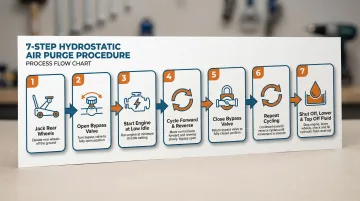
Repeat until the transmission operates quietly and wheels move normally.
Critical note: Confirm the exact purge steps for your specific Cub Cadet model using the OEM service manual, as the procedure varies slightly by model.
Step 3: Inspect and Adjust the Control Linkage and Neutral Setting
If the tractor creeps in neutral or has inconsistent response, the issue is often the transmission control rod being out of adjustment or the neutral position drifting due to worn linkage hardware.
Neutral adjustment procedure:
- Set tractor against a fixed object (wall or post)
- Jack rear wheels 1 inch off the ground
- Start engine at high idle in neutral
- Observe whether wheels rotate
If wheels rotate:
- Remove the flange lock nut and hex screw from the affected control rod
- Reposition the rod to the free hole in the control arm
- Reattach and test
Trunion mechanism wear (older models): On vintage Cub Cadet models (125, 682, 782) with Sundstrand units, the trunion mechanism—the spring-loaded bracket that controls pump input—wears over time, causing erratic hydro response. Worn trunion grooves can be restored by welding and filing back to specification or by installing a trunion repair bracket from specialty suppliers.
Step 4: Replace Seals, Filter, and Worn Internal Components
Once you've ruled out fluid condition, air in the system, and linkage problems, the fault is almost certainly internal. Worn seals cause pressure loss; a clogged or bypassing filter starves the circuit; significant pump or motor wear produces the rest.
Repair actions:
- Drain and replace the hydraulic filter
- Inspect and replace external seals accessible without full disassembly
- Check for obvious signs of damage (scored surfaces, broken springs, loose hardware) inside accessible portions
Internal rebuild scope: Replacing pistons, bearings, and valve plates inside the hydrostatic pump and motor requires precision measuring tools, model-specific service manuals, and hands-on experience with hydraulic components. At this stage, sending the unit to a specialist is faster and more cost-effective than a DIY teardown that risks damaging components you've already paid to diagnose.
Should You Repair or Replace Your Cub Cadet Hydrostatic Transmission?
Repair is almost always cheaper in the short term, but only if the root cause is correctable and the unit is not already at the end of its service life. A common rule of thumb: if repair costs exceed 50–60% of what a quality replacement transmission would cost, replacement usually makes more financial sense.
Fluid, Air, or Linkage Issues
Fix it. These repairs are inexpensive and low-risk — and in most cases, the transmission itself is perfectly fine. Any mechanically capable owner can handle them without professional help.
Trunion Wear or Seal Failure (Moderate Internal Wear)
Fix it: With correct parts and a service manual, trunion repair or seal replacement can restore performance. Consider engaging a professional rebuild service if the required disassembly is beyond your comfort level. Hydrostatic Pump Repair rebuilds units to manufacturer specifications — including hard-to-find components for older Cub Cadet and Sundstrand models — and backs every rebuilt unit with a one-year warranty.
Replace it: If multiple internal components are worn simultaneously or repair parts are unavailable for the model.
Progressive Pressure Loss Under Load (Pump/Motor Wear)
Fix it: A professional rebuild of the hydrostatic pump or motor can restore pressure and performance for a fraction of replacement cost. This is especially true on mid-range and higher-end Cub Cadet models, where sourcing a replacement transmission carries a significant price premium.
Replace it: If the unit has extremely high hours, has been run dry, or has been towed. Towing a hydrostatic tractor is one of the fastest ways to destroy the pump irreparably.
Catastrophic Internal Failure (Seized, Scored, or Broken Components)
Replace it. When internal scoring, broken pistons, or a seized motor are confirmed, the cost of sourcing and fitting all damaged components typically exceeds the value of a quality replacement or rebuilt exchange unit.
Preventive Maintenance to Extend Transmission Life
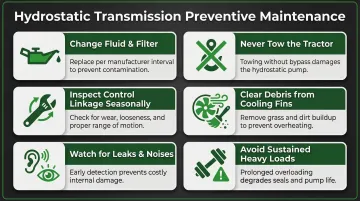
These six habits prevent the majority of hydrostatic transmission failures before they start.
Change fluid and filter on schedule: Follow the intervals in your Cub Cadet owner's manual—typically every 200-250 hours or annually. Dirty or degraded fluid is the leading cause of premature internal wear.
Don't tow the tractor: Cub Cadet explicitly warns that towing will cause severe damage to the transmission. The manual bypass valve is designed only for pushing the mower short distances at speeds under 2 mph.
Inspect control linkage seasonally: Check the linkage, neutral adjustment, and all pivot points once per season for wear, looseness, and lubrication. Catching a drifting neutral or worn trunnion early prevents internal damage.
Clear debris from cooling fins: Buildup on the transaxle housing acts as a "thermal blanket," trapping heat and accelerating oil breakdown. Clean the fan and housing fins regularly.
Watch for leaks and unusual noises: Check fluid level before each mowing season. Early intervention costs less than reactive repair.
Avoid sustained heavy loads: Full-speed slope climbing or towing beyond rated capacity overloads hydraulic pressure and accelerates seal and component wear—especially in warm weather.
Conclusion
Most Cub Cadet hydrostatic transmission problems—creeping in neutral, loss of drive, sluggish performance—respond well to systematic troubleshooting. Start with fluid, air, and linkage checks before assuming internal failure.
That said, internal wear is a different problem. If basic adjustments don't restore performance, a specialist rebuild is often cheaper than full replacement. Contact Hydrostatic Pump Repair at 1-800-361-0028 before writing off the transmission entirely.
Frequently Asked Questions
Can you service a Cub Cadet hydrostatic transmission?
Yes, basic service—fluid and filter changes, neutral adjustment, purging air—can be done by owners at home using the OEM service manual. Internal rebuild work typically requires professional tools and expertise.
Can a hydrostatic transmission be rebuilt?
Yes, most Cub Cadet hydrostatic transmissions—including older Sundstrand units—can be rebuilt by replacing worn internal components like seals, valve plates, and the trunnion mechanism, provided parts are available and the housing is not damaged.
Is it cheaper to fix a transmission or replace it?
Repair is almost always cheaper for moderate wear issues. However, if internal damage is extensive, a rebuilt exchange unit or compatible replacement transmission can sometimes be more cost-effective than sourcing all individual parts.
What are common hydrostatic transmission problems?
The most frequent issues include creeping in neutral, loss of drive power, sluggish uphill performance, overheating, and whining or cavitation noises. Most trace back to fluid condition, air in the system, or worn linkage components.
How many hours should a hydrostatic transmission last?
With proper fluid maintenance and appropriate use, a Cub Cadet hydrostatic transmission can last 1,500–2,500+ hours. Towing, running dry, or skipping fluid changes dramatically shortens lifespan.
What fluid does a Cub Cadet hydrostatic transmission use?
Most modern Cub Cadet models specify SAE 20W-50 Full Synthetic Hydrostatic Transmission Fluid. Older models with Sundstrand units commonly used Hy-Tran or an equivalent fluid.