Repair Guide](https://file-host.link/website/hydrostaticpumprepair-fthmsm/assets/refined-images/1777349693540000_5fc3e410927c49749027a83d4c8b02d0/360.webp)
Introduction
The John Deere L120 is a widely used residential lawn tractor, and its hydrostatic transmission — the Tuff Torq K46 — ranks among the most commonly discussed failure points among L120 owners. Most L120 transmission problems follow a predictable pattern: gradual power loss on hills, weak reverse, and heat-related shutdowns, typically appearing after 150–400 hours of use.
This guide covers:
- How to identify what's wrong with the K46 transmission
- How to approach a repair (and what it actually involves)
- When repair makes sense versus full replacement
- When the job calls for a professional
Key Takeaways
- The L120 uses a sealed Tuff Torq K46 transaxle — no external drain plug, no dipstick
- Common symptoms include loss of pulling power on hills after warm-up, weak or no reverse, and loud whining
- Heat-related internal wear and degraded fluid trapped in a sealed unit drive most failures
- Repair costs range from a fluid change ($30–$50) to a rebuild kit ($250–$350) to full K46/K66 replacement ($600–$2,750)
- Professional repair is the right call when the unit has failed completely or you're considering a K66 upgrade
What Is the Hydrostatic Transmission on a John Deere L120?
The L120 uses a Tuff Torq K46 hydrostatic transaxle — a single integrated unit that combines the hydraulic pump, drive motor, and final gear/differential to control forward/reverse movement without a manual gear shift.
How It Works
Hydrostatic transmissions pressurize hydraulic fluid to transfer engine power to the rear wheels. The K46 is designed as a "sealed for life" unit — no external drain plug, fill port, or oil dipstick is accessible during normal operation.
That design creates a real maintenance problem: fluid degrades over time, but the manufacturer provides no straightforward way to change it.
The K46's Place in the Market
That sealed design isn't unique to John Deere. The K46 appears across many residential mower brands at this price point, including Craftsman, Husqvarna, and MTD. Its limitations are well-documented:
- Built for light residential use, not heavy-duty or commercial workloads
- Prone to degradation from heat, frequent use, and neglected fluid
- No serviceable fill or drain point in the stock configuration
- Widely considered a known weak point on the L120
Common Problems With the John Deere L120 Hydrostatic Transmission
Most L120 transmission failures follow four recognizable patterns — and they almost always worsen gradually, giving you a window to diagnose the problem before it becomes a full rebuild.
Loss of Power on Hills After Warm-Up
The tractor climbs hills normally when cold, but after 15–30 minutes of use, forward speed drops and it stalls on inclines. Resting for 30–60 minutes temporarily restores performance.
This heat-dependent pattern points to internal hydraulic pressure loss. Worn pump pistons or check valve springs can no longer maintain pressure once operating temperature rises. Community data shows failures typically manifest between 150 and 400 hours of use — so if your L120 is in that range, treat this symptom as a warning, not an anomaly.
Weak or No Reverse
Forward motion feels acceptable, but reverse is sluggish, requires heavy pedal force, or produces no movement — especially on even a slight incline.
This is often the first failure symptom owners notice. The K46's reverse circuit is more sensitive to internal wear than the forward circuit, so degraded oil viscosity and worn components hit reverse pressure first. Think of it as an early warning before forward drive starts to go.
Loud Whining or Grinding Noise From the Rear
A persistent high-pitched whine or grinding sound from the transmission area during operation — often worsening under load or on hills — points to internal mechanical wear.
Worn gear surfaces, metal-to-metal contact from degraded lubrication, or debris circulating in the fluid are the usual culprits. A grinding sound that appears suddenly (rather than developing gradually) is more serious and may indicate internal gear failure, such as spider gear damage.
Transmission Works Fine but Tractor Won't Move
The engine runs normally, blades engage, and the drive belt looks intact — but the tractor doesn't move in either direction, or rolls a few feet and stops.
Before assuming the worst, check the freewheel/bypass lever at the rear of the tractor. If it's been accidentally engaged, the transmission is mechanically disconnected and the fix takes seconds. If the lever is properly set, you're likely looking at complete internal failure of the hydraulic pump or motor, or a snapped axle key.
Why the L120 Transmission Fails
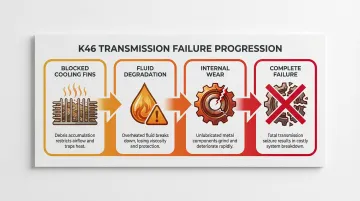
The core issue: the K46 was designed as a cost-optimized, light-duty transaxle and lacks an external serviceable fluid system. Over time, heat cycles degrade the hydraulic fluid, the internal filter becomes clogged, and worn components (particularly the powdered-metal spider gears and clutch plates) begin to fail.
One frequently missed contributor is grass and debris accumulating on the transmission fan's cooling fins. When airflow is blocked, operating temperature spikes and accelerates all internal wear. Tuff Torq warns that obstructed cooling fins cause severe overheating and premature failure — a pattern seen consistently in K46-equipped machines.
That overheating shows up early as whining under load or sluggish reverse. Ignoring those signals leads to complete failure. Once internal metal particles circulate freely, the hydraulic pump and motor sustain damage that a fluid change alone won't fix.
How to Fix the John Deere L120 Hydrostatic Transmission
Attempting a fix without first diagnosing the actual condition of the transmission wastes time and money. The right repair approach depends entirely on whether the unit needs fluid service, a rebuild, or full replacement.
Step 1: Inspect Before Disassembling
Check the cooling fins:
- Located under the tractor behind the rear axle area
- Clean thoroughly with compressed air or a stiff brush
- This alone can improve performance in early-stage overheating cases
Verify basic operation:
- Confirm the freewheel/bypass lever at the rear hitch is fully pushed in (engaged position)
- Confirm the drive belt is intact and properly tensioned
- Confirm the tractor's brake is releasing fully when the pedal is depressed
Step 2: Perform a Fluid Change (Early-Stage Failure)
Changing the fluid requires removing the transaxle from the tractor (4 mounting bolts, drive belt, brake rod, and axle keys). The unit must be inverted to drain through the breather/fill plug located under the cooling fan and drive pulley (remove the pulley first).
Fluid Specifications:
Once drained, refill with 2–2.5 quarts of 5W-50 full synthetic motor oil (Tuff Torq's recommended specification). The factory fill is often conventional oil, and switching to synthetic improves heat resistance and extends unit life.
Bleeding the System:
Reinstall and bleed the transmission by slowly cycling forward/reverse pedals until smooth operation is achieved.
Step 3: Rebuild the K46 (Moderate Wear)
If a fluid change does not restore performance, Tuff Torq sells rebuild kits (including replacement spider gears, thrust bearings, and center case components) for $250–$350. This is appropriate when the unit has worn internals but no catastrophic failure.
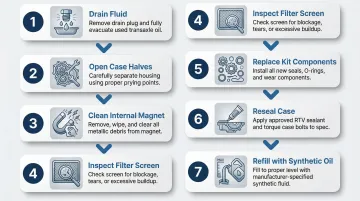
Rebuild Process:
- Drain all fluid
- Open the case halves
- Clean the internal magnet of metal debris
- Inspect the filter screen (clean or replace)
- Replace all components in the kit
- Reseal with a high-strength liquid gasket
- Refill with fresh 5W-50 synthetic oil
Rebuilt K46 units often repeat failure under heavy hill-mowing use — factor that into your decision before committing to a rebuild.
Step 4: Replace the Transmission
If rebuilding is not practical or the unit has failed catastrophically, the K46 can be replaced with a new OEM-equivalent unit ($600–$800 depending on source). For owners dealing with recurring failures, though, a like-for-like replacement just resets the clock on the same underlying problem.
The K66 Upgrade Option:
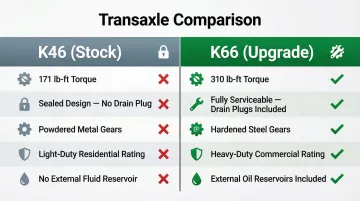
A Tuff Torq K66 transaxle upgrade is a popular solution among L120 owners. The K66 offers:
- Roughly twice the torque (310 lb-ft vs. 171 lb-ft)
- Fully serviceable design with external oil reservoirs and drain plugs
- Steel gears instead of powdered metal
- Long-term reliability
The K66 requires larger rear wheels (23×10.50-12) and frame modifications. Installation takes 4–6 hours for a competent DIYer. Research and confirm compatibility for your specific L120 model year before purchasing.
For sourcing the right transaxle and parts for your model, contact a hydrostatic transmission specialist such as Hydrostatic Pump Repair at 800-361-0028.
Step 5: Test and Validate the Fix
After any repair or replacement:
- Run the tractor on flat ground first to purge any air from the system
- Test on a moderate incline at operating temperature (after 20+ minutes of use)
- Check for fluid leaks around axle seals and the case perimeter after the first few hours of use
Should You Fix or Replace the John Deere L120 Hydrostatic Transmission?
The right call depends on how far the damage has progressed, what the rest of the tractor looks like, and how you plan to use it going forward. Each scenario below maps symptoms to a clear recommendation.
Scenario 1: Early Symptoms (Weak Reverse, Mild Hill Power Loss, Under 300 Hours)
Fix: Fluid change with 5W-50 full synthetic is a low-cost first step ($30–$50 in parts, plus labor to remove and reinstall the unit). If the tractor is otherwise in good condition, this can extend transmission life by one to three mowing seasons.
Replace: Not warranted at this stage unless the fluid change shows no improvement after a full test cycle.
Scenario 2: Moderate Wear (Persistent Whining, Fails on Hills After Warm-Up, 300–500 Hours)
Fix: A Tuff Torq K46 rebuild kit ($250–$350) is appropriate if the owner is mechanically experienced. Pair with a full fluid change and internal filter cleaning for best results.
Replace: If the tractor is otherwise in good shape and used on hills regularly, upgrading to the K66 is the more durable long-term investment. If you'd rather rebuild the existing unit professionally, Hydrostatic Pump Repair (800-361-0028) specializes in hydrostatic transmission rebuilds and can advise on the right approach for your model.
Scenario 3: Complete Failure (Tractor Won't Move, Grinding Noise, Heavy Metal in Fluid)
Fix: Rebuilding is generally not cost-effective once catastrophic internal damage (broken spider gears, scored pump surfaces) has occurred. Parts cost plus labor often exceeds the cost of a new unit.
Replace: Install a new K46 ($600–$800) if budget is the primary constraint, or upgrade to a K66 for long-term reliability. Weigh this against the overall tractor value and remaining component life.
Scenario 4: High Hours, Multiple Component Wear (500+ Hours, Other Issues Present)
Fix: Investing $600–$1,800 in a transmission on a tractor with worn deck spindles, high engine hours, and cracked hood components may not make financial sense.
Replace the Tractor: If the L120 has significant hours and other costly issues alongside the transmission, sourcing a newer machine or a model with a serviceable transmission is likely the better long-term decision.
Preventive Measures to Extend Transmission Life
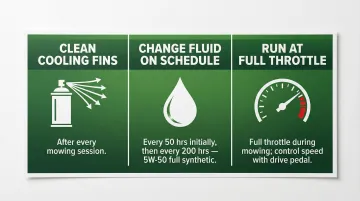
Most L120 transmission failures are preventable. These three habits cover the most common causes of premature wear and overheating.
Clean the Cooling Fins After Every Session
- Blow out the transmission cooling fins with compressed air after each mowing session
- Grass and debris buildup is the single most preventable cause of overheating
- Check fins at the start and midpoint of every mowing season
Change the Fluid on Schedule
- Remove the transaxle and drain/refill with 5W-50 full synthetic every 50 hours initially, then every 200 hours
- This is the manufacturer-recommended interval that most L120 owners skip — because it requires transaxle removal — and it's the leading cause of premature wear
Run at Full Throttle When Mowing
- Set the throttle to full open during mowing, as specified in the operator manual
- Partial throttle forces the hydrostatic pump to work harder under load and generates excess heat
- Control ground speed with the drive pedal, not the throttle
Conclusion
Most John Deere L120 hydrostatic transmission problems are fixable if caught early. A fluid change or rebuild can restore performance and add meaningful service life when the unit has not yet failed catastrophically.
Correct diagnosis drives every successful repair decision. Understanding whether the issue is a fluid/heat problem, internal wear, or complete component failure determines whether a $50 fluid change, a $350 rebuild, or a full transmission swap is the right course of action.
Knowing when to repair, when to replace, and when to upgrade to a more capable K66 unit saves both money and downtime. When in doubt, a hydrostatic transmission specialist like Hydrostatic Pump Repair (800-361-0028) can identify the root cause and recommend the right repair path.
Frequently Asked Questions
What are common hydrostatic transmission problems and symptoms on a John Deere L120?
The four main symptoms are heat-related power loss on hills after 15-30 minutes of operation, weak or absent reverse (especially on inclines), loud whining or grinding noises from the rear of the tractor, and eventual inability to move in either direction. These symptoms typically appear between 150 and 400 hours of use.
What transmission is in a John Deere L120?
The L120 uses a Tuff Torq K46 hydrostatic transaxle, a sealed unit with no external drain plug or dipstick. This light-duty integrated transaxle is shared with many other residential tractor brands in the same price range, including Craftsman, Husqvarna, and MTD.
Is it cheaper to repair or replace the hydrostatic transmission on a John Deere L120?
A fluid change ($30–$50) or rebuild kit ($250–$350) is far cheaper than a new K46 ($600–$800) or K66 upgrade ($2,750). However, repair is only cost-effective when the damage is not catastrophic and the rest of the tractor is in good condition with reasonable remaining service life.
How do you change the transmission fluid on a John Deere L120?
The K46 has no accessible drain plug during normal use. The transaxle must be removed from the tractor, inverted, and drained through the breather plug after the cooling fan and drive pulley are removed. Refill with 2–2.5 quarts of 5W-50 full synthetic oil.
How long does a John Deere L120 hydrostatic transmission last?
Under typical residential use, the K46 commonly begins showing symptoms between 150–400 hours. Proactive fluid changes using synthetic oil and regular cooling fin cleaning extend service life, though heavy use or hilly terrain shortens it considerably.
Can I upgrade the K46 transmission in my John Deere L120?
Yes. The Tuff Torq K66 is a proven upgrade that fits the L120 with larger rear wheels and minor frame modifications. It offers roughly twice the torque and a fully serviceable design. Installation takes 4–6 hours and suits a mechanically confident DIYer.