Introduction
Kawasaki hydraulic pumps—including the K3V, K5V, K7V, and K3VLS series—are precision-engineered axial piston pumps widely used in excavators, construction machinery, industrial presses, and mobile equipment. These pumps operate at high efficiency, but only when properly maintained. Their tight internal tolerances and swash-plate design demand clean fluid, correct viscosity, and consistent upkeep to perform at peak levels.
The cost of neglect is steep. Hydraulic pump failures trigger unplanned downtime averaging $740 per hour in construction and material handling, scaling to $10,000+ per hour in critical industrial applications. Beyond lost productivity, failed pumps cause secondary damage to valves, actuators, and cylinders. What starts as a preventable maintenance issue can escalate into a full system failure.
This guide covers why Kawasaki pump maintenance matters, the four maintenance types you should understand, early warning signs to watch for, and a practical maintenance schedule that keeps your equipment running.
Key Takeaways
- Kawasaki pumps are precision axial piston units with tight tolerances, making them highly sensitive to contamination and incorrect fluid viscosity
- Four maintenance types apply: routine/preventive, corrective/reactive, predictive/condition-based, and major overhaul
- Oil contamination and cavitation cause 70–90% of Kawasaki pump failures and are largely preventable
- Catch warning signs early — pressure loss, abnormal noise, overheating, and visible leaks — before they escalate to catastrophic failure
- Structured maintenance schedules extend pump lifespan and protect your equipment investment
Why Kawasaki Hydraulic Pump Maintenance Matters
Efficiency Degradation Costs Money
Kawasaki pumps are designed for maximum power density and efficiency. The K3VLS series maintains high efficiency across its full operating range, while the K7V series was optimized using computational fluid dynamics to achieve 3 percentage points higher efficiency than existing pumps in normal operation. Poor maintenance directly degrades this efficiency, leading to higher fuel consumption and reduced machine output.
Contamination Destroys Precision Surfaces
Kawasaki's swash-plate axial piston design relies on precise sliding clearances between the cylinder block, pistons, piston shoes, and valve plate. Contaminated or degraded hydraulic fluid acts as a lapping compound, eroding these surfaces and accelerating wear. Left unchecked, pump lifespan drops from thousands of hours to hundreds.
The 3-5x Reactive Maintenance Penalty
Reactive hydraulic maintenance costs 3 to 5 times more than planned preventive care. Emergency repairs incur rushed parts orders, overtime labor, expedited shipping, and—most significantly—unplanned downtime. Heavy equipment downtime costs average $740 per hour, and in critical industrial applications, that figure can exceed $10,000 per hour.
Safety, Compliance, and Long-Term Value
Beyond cost, consistent maintenance protects people and equipment across the environments where Kawasaki pumps work hardest:
- Prevents sudden pressure loss in excavators, cranes, and press machines — where failures create immediate safety hazards
- Supports compliance with OEM service intervals, reducing liability exposure
- Preserves ROI on high-value components operating in construction, agriculture, marine, and industrial applications
- Extends service life in harsh duty cycles where contamination and thermal stress accelerate wear
Types of Maintenance for Kawasaki Hydraulic Pumps
No single maintenance approach fits all scenarios. The right strategy depends on operating hours, application severity, environment, and the specific Kawasaki pump series in use.
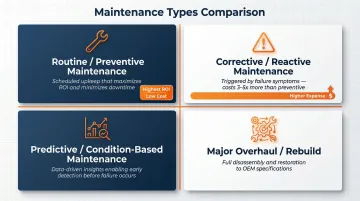
Routine / Preventive Maintenance
Core tasks include:
- Checking hydraulic fluid level and condition
- Inspecting external fittings and hoses for leaks
- Verifying inlet filter cleanliness
- Monitoring case drain flow
- Checking for debris around the pump cooling fan
These low-cost tasks prevent 70–80% of pump failures when performed consistently. Preventive maintenance is generally low-cost—fluid, filters, inspection labor—but delivers the highest ROI. It's appropriate for all Kawasaki pump models in standard operating conditions.
Corrective / Reactive Maintenance
Corrective maintenance is triggered when a symptom appears: pressure loss, noise, leakage, or overheating. Common corrective tasks include seal replacement, valve plate inspection, and pressure testing to isolate the fault.
Caution: By the time symptoms appear in Kawasaki axial piston pumps, internal wear may already be advanced. Cavitation damage to cylinder bores and valve plates often requires full component replacement to correct — pushing repair costs well beyond what early intervention would have cost.
Predictive / Condition-Based Maintenance
Condition-based monitoring tracks:
- Case drain flow rate
- System pressure readings
- Oil temperature trends
- Hydraulic fluid particle count (oil analysis)
These provide early warning of internal wear before failure occurs. Newer Kawasaki equipment with onboard telematics can log this data automatically. For operators without that capability, scheduled oil sampling and flow testing every 500–1,000 hours serve the same purpose.
Major / Overhaul Maintenance
A full Kawasaki pump overhaul involves disassembly of the swash plate, cylinder block, pistons, shoe plate, bearings, and drive shaft. Technicians inspect and replace worn components, then reassemble with new seals, O-rings, and gaskets following OEM specifications as outlined in K3V/K5V and K7V repair manuals.
When to overhaul:
- Flow test results show excessive flow droop
- Internal surfaces are scored or grooved
- The pump has reached its rated service hours
When an overhaul is warranted, verify that your repair provider stocks OEM-spec components for your specific Kawasaki series — K3V, K5V, and K7V pumps each have distinct tolerances that generic parts won't meet. Hydrostatic Pump Repair carries parts and rebuild expertise across all major Kawasaki pump families.
How to Tell If Your Kawasaki Hydraulic Pump Needs Maintenance
Catching early indicators prevents minor issues from escalating into full pump failure.
Loss of Pressure or Flow Performance
Reduced system pressure or sluggish actuator response is often the first measurable sign of pump wear. For Kawasaki axial piston pumps, this is typically caused by worn valve plates, scored cylinder bores, or excessive piston-to-bore clearance allowing internal bypass.
Recommendation: Perform flow testing using a bi-directional flow meter. Compare actual output against rated specifications (referencing Kawasaki's published specs for the relevant series). An acceptable flow "droop" threshold exists; exceeding it confirms the pump needs service.
Abnormal Noise or Vibration
Key sounds to watch for:
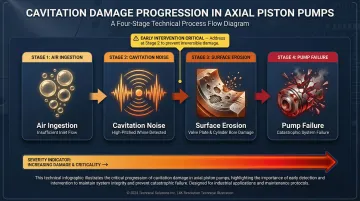
- High-pitched whine or cavitation noise — caused by insufficient inlet flow or air ingestion
- Metallic knocking or grinding — indicating bearing or piston damage
- Irregular pressure pulsation — signaling internal distress
Cavitation is especially destructive in swash-plate piston pumps: imploding air bubbles erode the valve plate, cylinder bore, and shoe surfaces. Investigate at the first sign of cavitation noise — continued operation accelerates internal erosion rapidly.
Visible Leaks, Overheating, or Fluid Contamination
Visible indicators include:
- Oil weeping from shaft seals or case drain ports (seal failure)
- Hydraulic fluid that appears milky (water contamination) or dark and metallic (particle contamination)
- Operating temperatures consistently above normal range
Overheating in Kawasaki pumps is often caused by excessive loading, contaminated fluid, clogged cooling fans, or air trapped in the system. Identify the root cause before returning the pump to service — treating the symptom without addressing the source leads to repeat failure.
Increased Input Energy or Cycle Times
As internal efficiency drops, the prime mover (engine or electric motor) must work harder to maintain system output. Watch for these early warning signs:
- Higher fuel consumption or elevated engine load readings
- Slower cycle times on tasks the machine previously completed without strain
- Difficulty maintaining pressure under loads that were previously manageable
Efficiency loss is deceptive — machines often keep running while output has already degraded well below spec. Scheduled flow testing and oil analysis catch this before it becomes a breakdown.
Kawasaki Hydraulic Pump Maintenance Schedule
Maintenance intervals vary by operating conditions. A pump running continuous heavy-duty cycles in dusty, high-temperature environments needs more frequent attention than one used intermittently in controlled conditions. Always cross-reference with your specific Kawasaki pump model's OEM service documentation before setting any schedule.
Maintenance Frequency Guidelines
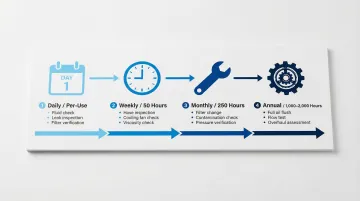
| Interval | Tasks |
|---|---|
| Daily / Per-Use | Check hydraulic fluid level; inspect for visible leaks at fittings, seals, and case drain; verify inlet filter is not restricted; confirm bypass valve is fully closed during operation |
| Weekly / Every 50 Hours | Inspect all external hoses and connections for wear or leaks; check cooling fan for debris obstruction; verify correct fluid viscosity and cleanliness; listen for abnormal noise at startup |
| Monthly / Every 250 Hours | Change inlet filter or inspect per OEM recommendation; check fluid for contamination (color, odor, particle content); verify system pressure readings against rated specifications; inspect control linkage and trunnion arm for wear |
| Annual / Every 1,000–2,000 Hours | Conduct full oil change with flush; perform flow test to assess volumetric efficiency; inspect internal components if efficiency has degraded; determine whether the pump needs overhaul or replacement |
Critical Filtration Requirements
To maintain Kawasaki's mandated ISO 4406 -/18/15 (NAS Class 9) cleanliness level:
- Return line: Install a nominal 10 µm (micron) filter
- Suction line: Install an 80 to 150 mesh strainer
Fluid Specifications
K3V/K5V series pumps have specific fluid requirements that directly affect service life:
- Viscosity range: 10 to 1,000 cSt
- Operating temperature range: -20 to +95°C
- Fluid type: Confirm compatibility with your model's technical datasheet before servicing
Conclusion
Kawasaki hydraulic pumps are built to tight tolerances — and that precision is exactly what makes them sensitive to neglect. A structured maintenance plan is the most reliable way to protect performance and extend service life.
The right maintenance approach balances cost and reliability: preventive and condition-based maintenance catch issues early at low cost, while reactive maintenance and emergency overhauls are significantly more expensive. Investing in routine care protects the long-term value of any Kawasaki-powered system.
When repairs go beyond routine maintenance, that investment logic holds even more. Working with a specialist rebuild provider like Hydrostatic Pump Repair — which remanufactures pumps to OEM specifications across all major Kawasaki series — ensures the technical precision these systems require.
Frequently Asked Questions
Why is my Kawasaki hydraulic pump not producing enough pressure?
Low pressure output in Kawasaki axial piston pumps is typically caused by worn valve plates, scored cylinder bores, excessive piston clearance, or a faulty pressure regulator. A flow test can confirm whether the issue is internal wear or a circuit problem.
What is the most common cause of Kawasaki hydraulic pump failure?
Hydraulic fluid contamination is the leading cause of Kawasaki pump failure. Particulates erode precision sliding surfaces (pistons, valve plate, cylinder block), while water contamination and incorrect fluid viscosity accelerate bearing and seal damage.
How do I maintain a Kawasaki hydraulic pump?
Maintain clean hydraulic fluid at the correct viscosity, replace inlet filters per schedule, inspect seals and fittings regularly for leaks, monitor case drain flow, and perform periodic flow testing to catch efficiency loss early.
What happens if you spin a Kawasaki hydraulic pump backwards?
Running a Kawasaki axial piston pump in the wrong rotation direction is destructive. The charge pump and valve plate are directionally specific — reverse rotation immediately starves internal lubrication and pressure, causing rapid seizure of pistons, bearings, and sliding surfaces.
Are Kawasaki hydraulic pumps any good?
Kawasaki hydraulic pumps (K3V, K5V, K7V, K3VLS series) are well-regarded across construction, agricultural, and industrial equipment. They deliver over 90% pump efficiency and are built for high-cycle, high-load applications — which explains their widespread adoption in demanding machinery worldwide.