Introduction
The excavator hydraulic pump converts engine power into the hydraulic force behind every movement: boom lift, swing, bucket curl, and travel. When it fails, operations stop entirely. Pump failure is one of the costliest issues excavator operators face — yet most warning signs get ignored or misdiagnosed until catastrophic damage is done.
Studies show that 65% to 90% of hydraulic system failures stem from preventable causes like contamination and cavitation. Catching early symptoms — unusual noise, pressure loss, overheating — can mean the difference between a minor repair and a full replacement costing thousands of dollars and days of downtime.
Key Takeaways
- Excavator hydraulic pumps power all machine movement; failure halts operations completely
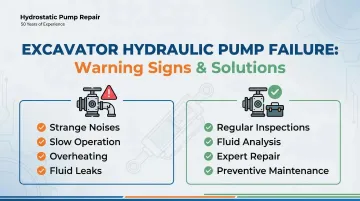
- Key warning signs: whining or grinding noise, slow operation, pressure loss, and visible fluid leaks
- Most failures stem from contamination, cavitation, overheating, seal wear, or neglected maintenance
- Catch damage early and repair is often viable — internal scoring or cracking typically means full replacement
- Professional diagnosis prevents misdiagnosis and wasted repair costs
What Is an Excavator Hydraulic Pump?
The excavator hydraulic pump draws hydraulic fluid from the reservoir, pressurizes it, and sends it to actuators—boom, arm, bucket, swing motor, and travel motors—that perform all mechanical work. Without it, the excavator cannot function.
Modern excavators rely almost exclusively on axial piston pumps due to their ability to handle variable pressure and high flow demands. These pumps use pistons arranged in a rotating cylinder block around a drive shaft. By adjusting the angle of an internal swashplate, the pump varies its displacement and output flow to match the machine's immediate load demands.
Operating pressures are severe — for reference:
- Komatsu PC490LC-11: 37.3 MPa (~5,400 PSI)
- Volvo EC220E: 34.3 MPa (~4,980 PSI)
Under these conditions, hydraulic pumps are wear components. Heat, contamination, and mechanical stress degrade them over time — which is exactly why recognizing early failure signs matters.
Warning Signs Your Excavator Hydraulic Pump Is Failing
Catching pump failure early is the difference between a rebuild and a full replacement. These are the symptoms that show up first—and what they mean.
Unusual Noise from the Pump
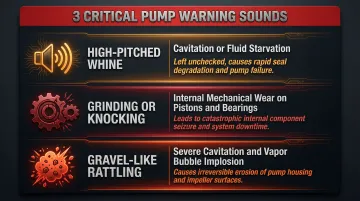
Whining, screeching, or grinding sounds are the most immediate warning signs:
- High-pitched whine typically indicates cavitation—the pump is starved of fluid
- Grinding or knocking suggests internal mechanical wear on pistons, bearings, or the drive shaft
- Gravel-like rattling signals severe cavitation as vapor bubbles violently implode against internal surfaces
When you hear these sounds, the pump is already sustaining damage. Continued operation compounds wear on pistons and bearings—components that are expensive to replace.
Hydraulic Pressure Loss
When the pump can no longer maintain system pressure, the excavator loses power:
- Buckets won't dig with full force
- Boom lifts slowly or not at all
- Swing response becomes sluggish
- All functions feel weak or unresponsive
This often points to worn internal components, cracked pump housing, or bypassing relief valves. A pressure test at the pump outlet (using a calibrated gauge) confirms whether output falls below the manufacturer's rated system pressure—3,000 to 5,500 PSI for mid-size to large excavators.
Overheating Hydraulic Fluid
An inefficient or failing pump forces the system to work harder, generating excess heat:
- High fluid temperature warnings on the dash
- Burnt smell from hydraulic oil
- Discolored (darkened) hydraulic fluid
- Hot-to-the-touch hoses and reservoir
Sustained temperatures above 82°C (180°F) degrade fluid viscosity, damage seals, and accelerate bearing wear. If your fluid is already darkened or burnt-smelling, the seals and bearings have likely already taken damage—check them before returning the machine to service.
Visible Fluid Leaks Around the Pump
Oil pooling beneath the machine, wet patches on hose connections, or residue on the pump housing indicate seal or O-ring failure. Even small leaks:
- Reduce system pressure
- Introduce contamination risk
- Cause cavitation as fluid level drops
- Signal internal wear that allows fluid to escape
Slow, Jerky, or Erratic Hydraulic Functions
Delayed boom response, inconsistent bucket curl, or jerky swing movement indicate irregular fluid delivery. This can result from:
- Internal wear causing pressure fluctuations
- Air trapped in the system
- Partially blocked suction line affecting pump output
- Worn valve plate or cylinder block
Root Causes of Excavator Hydraulic Pump Failure
Fixing symptoms without identifying the root cause guarantees repeat failure. Excavator hydraulic pump failures trace back to four core problems, each with distinct mechanisms and warning patterns.
Contamination
Dirty hydraulic fluid is the leading cause of pump failure. Estimates across the hydraulic industry place contamination behind 65% to 90% of all hydraulic system failures. Dirt, water, and metal particles enter through:
- Worn seals
- Improper fluid changes
- Contaminated storage containers
- Inadequate filtration
These particles cause abrasive wear on pump internals, scoring pistons and valve plates. The damage accelerates faster than any other failure mode.
Cavitation
Cavitation occurs when the pump inlet cannot receive adequate fluid due to:
- Clogged suction filters
- Collapsed hoses
- Low fluid levels
- Restricted inlet lines
When the pump pulls in air bubbles instead of fluid, those bubbles collapse under pressure, creating micro-shockwaves that pit and erode internal pump surfaces. Cavitation sounds like gravel in the pump and causes rapid catastrophic damage if not addressed immediately.
Overheating and Fluid Degradation
Sustained high operating temperatures break down hydraulic fluid viscosity, reducing its ability to lubricate and transfer hydraulic pressure. This accelerates seal failure and bearing wear. Common causes include:
- Insufficient cooling capacity
- Low fluid level
- Running the machine at high load for extended periods without rest
- Clogged cooler fins or radiator
Wear, Misalignment, and Neglected Maintenance
Normal operational wear on pistons, slipper pads, cylinder blocks, and drive shaft bearings eventually causes internal leakage (bypassing) that reduces pressure output. Additionally:
- Improper pump mounting causes vibration
- Drive coupling misalignment creates uneven loading
- Both conditions shorten pump life
Catching misalignment and wear early — through regular inspection intervals — prevents the kind of progressive internal damage that turns a rebuild into a full replacement.

How to Fix Your Excavator Hydraulic Pump (Step-by-Step)
Attempting repairs before confirming the root cause wastes time and money—start by diagnosing accurately.
Step 1: Identify the Symptom and Document the Pattern
Note exactly when and how the issue occurs:
- At startup, under load, during specific functions, or continuously?
- Which hydraulic functions are affected?
- What sounds do you hear?
Check fluid level and color, listen for abnormal sounds, and observe machine behavior. Document all symptoms before touching any components.
Step 2: Run a Pressure Test to Confirm Pump Output
A hydraulic pressure gauge test at the pump outlet is the most reliable way to confirm whether the pump is the actual source versus a failing relief valve, blocked line, or cylinder issue. Readings well below the manufacturer's rated system pressure (typically 3,000 to 5,500 PSI for excavators, though exact specs vary by model) point to internal pump wear or bypass.
Step 3: Inspect and Address the Root Cause
This step varies by identified cause and is where most repair cost and error occurs:
If the issue is contamination:
- Drain and flush the entire hydraulic system
- Replace all filters (suction, return, and case drain)
- Inspect and clean the reservoir
- Refill with manufacturer-approved hydraulic fluid to the correct grade
- Re-inspect pump internals for scoring damage
If the issue is cavitation:
- Inspect and replace the suction strainer/filter
- Check suction hose for collapse or restrictions
- Verify fluid level is adequate
- Bleed air from the system per the manufacturer's procedure
- Inspect the pump inlet for any restriction
If the issue is internal mechanical wear:
Worn pistons, bearings, or valve plates typically require pump disassembly, inspection, and rebuild or component replacement. For complex internal repairs, a specialized provider like Hydrostatic Pump Repair carries correct parts for all major excavator brands—Komatsu, Caterpillar, Volvo, Hitachi, Kawasaki, and Rexroth—which matters when sourcing components that must meet OEM specifications.
Step 4: Reassemble, Prime, and Test Under Load
After any repair, the pump must be properly primed before starting:
- Fill the pump housing with clean hydraulic fluid through the case drain port (this prevents dry-start damage)
- Run the machine at low idle first
- Progressively test under load
- Monitor pressure output, fluid temperature, and noise
- Confirm the original symptoms are resolved and that no new leaks appear
When to Fix vs Replace Your Excavator Hydraulic Pump
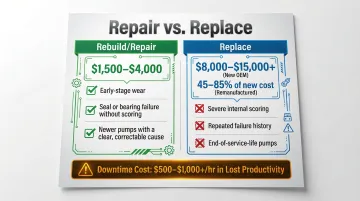
The fix versus replace decision comes down to the extent of internal damage, the age of the pump, and a realistic cost comparison. A rebuild typically costs a fraction of a new pump but only makes sense when core components are still serviceable.
Fix (Repair or Rebuild) When:
- The pump shows early-stage wear
- A seal or bearing has failed without scoring of the cylinder block or valve plate
- Cavitation damage is surface-level rather than structural
- The pump is relatively new and the failure has a clear correctable cause
Hydraulic pump rebuilds typically range from $1,500 to $4,000 depending on pump size and extent of damage, while new OEM pumps can cost $8,000 to $15,000 or more.
Replace When:
- The pump has severe internal scoring or cracking of the cylinder block, housing, or drive shaft
- The pump has failed twice within a short period (indicating a systemic issue that a rebuild won't fix permanently)
- The pump is at or beyond its expected service life and downtime costs make replacement more economical
- A rebuild quote approaches or exceeds the cost of a remanufactured unit
Downtime costs are what make this decision urgent. Construction equipment sitting idle can run $500 to $1,000+ per hour in lost productivity, idle crews, and project delays. A professionally remanufactured pump — rebuilt to OEM specifications — is often the fastest path back to operation, typically priced at 45% to 85% of a new unit and backed by a comparable warranty.
How to Prevent Excavator Hydraulic Pump Failures
Most hydraulic pump failures don't happen without warning — they're the result of skipped maintenance, dirty fluid, or ignored early symptoms. Contamination and cavitation, the two leading causes, are almost entirely preventable with three core practices: consistent fluid and filter service, daily operational checks, and strict contamination control.
Establish and Follow a Fluid and Filter Maintenance Schedule
Change hydraulic fluid and filters at manufacturer-recommended intervals. The table below shows standard schedules for common excavator brands:
| Manufacturer | Standard Fluid Interval | Extended Interval (with Oil Analysis) | Filter Change Interval | |--------------|-------------------------|---------------------------------------|------------------------|\n| Caterpillar | 2,000 hours | Up to 6,000 hours (with Cat HYDO Advanced 10 and S·O·S monitoring) | 500 hours | | Komatsu | 5,000 hours | N/A | 1,000 hours | | Volvo | 4,000 hours | As per analysis | 500 hours (first change) |
Important: Heavy hydraulic hammer use drastically reduces fluid intervals—sometimes to as little as 600 hours.
Regular fluid analysis (particle count and viscosity testing) can detect contamination or degradation before it causes damage. Always use the correct fluid grade for the operating temperature range.
Perform Daily Visual and Operational Checks
Operators should perform a pre-start inspection:
- Check fluid level
- Look for visible leaks around the pump and hoses
- Listen for abnormal startup noise
- Monitor temperature and pressure gauges during operation
Catching early symptoms during routine checks prevents minor issues from escalating to full pump failure.
Control Contamination and Operating Conditions
Daily checks catch operational problems — but contamination often enters the system during servicing, not operation. These habits close that gap:
- Use clean containers and tools every time you service the hydraulic system
- Store hydraulic fluid in sealed containers to prevent moisture ingress
- Avoid sustained high-load operation in extreme heat without allowing the system to cool
- Never bypass or leave suction filters clogged — this directly causes cavitation
- Target an ISO 4406 cleanliness code of 18/16/13 or better for high-pressure axial piston pumps
Frequently Asked Questions
How much does it cost to repair a hydraulic pump on an excavator?
Repair costs depend on the extent of damage and pump type. Seal and bearing repairs typically range from $1,500 to $3,000, full pump rebuilds cost $2,500 to $4,500, and new OEM pump replacements run $8,000 to $15,000+. A professional diagnosis before committing to replacement can prevent unnecessary spending.
How do I know if my hydraulic pump is bad in my excavator?
The most reliable indicators are abnormal whining or grinding noise, visible loss of digging or lifting power, overheating fluid, and confirmed low pressure on a gauge test. These symptoms together strongly point to the pump rather than other hydraulic components like relief valves or cylinders.
What is the most common cause of hydraulic pump failure?
Hydraulic fluid contamination is the leading cause, accounting for 65% to 90% of all failures. Dirt, water, and metal particles in the fluid cause abrasive internal wear on pump components. Cavitation from clogged suction filters or low fluid levels is the second most common cause.
What causes an excavator to lose hydraulic pressure?
Pressure loss can stem from internal pump wear (causing bypass), a mis-set or stuck relief valve, worn cylinder seals, or a blocked control valve. A pressure test at the pump outlet is the fastest way to determine whether the pump is the source or if the issue lies elsewhere in the system.
What will happen if there is air trapped in the hydraulic system?
Trapped air causes spongy or erratic control response, increased noise (cavitation), fluid aeration (foamy oil), and accelerated internal pump wear. Air must be bled from the system per the manufacturer's procedure to restore normal operation and prevent further damage.
What PSI should an excavator's relief valve be set to?
Excavator main relief valves typically range between 3,000 and 5,500 PSI depending on the machine — the Volvo EC220E is set to 4,980 PSI and the Komatsu PC490LC-11 to 5,400 PSI. Adjustments should only be made with a calibrated gauge by a qualified technician.