Introduction
The forklift hydraulic pump drives every lift, tilt, and load movement. When it fails, your operation stops. This single component creates the pressurized fluid flow that powers every function from raising a pallet to tilting the mast. Yet many facilities treat hydraulic maintenance as optional upkeep rather than the critical reliability investment it truly is.
The cost of neglect is steep and measurable. Unplanned forklift downtime costs warehouses approximately $10,000 per hour and manufacturing facilities $20,000 to $22,000 per hour, according to industry analysis. Beyond the repair bill itself, a failed pump triggers secondary damage to seals, cylinders, and fluid systems.
It also creates serious OSHA compliance exposure when an unsafe forklift stays in service.
This guide covers:
- Warning signs that demand immediate attention
- The four maintenance types suited to different failure stages
- Practical scheduling tied to operating hours
- When to escalate beyond in-house capability to professional pump repair
Key Takeaways
- Neglecting the hydraulic pump shortens its lifespan and raises the risk of unplanned downtime mid-shift
- Key warning signs: slow lifting, unusual noise, visible leaks, overheating
- Maintenance falls into four types — preventive, corrective, predictive, and full overhaul — each with a different role in keeping equipment running
- Change hydraulic oil every 1,000 hours; filters every 500–1,000 hours
- OSHA requires immediate removal of unsafe forklifts until inspected and cleared for service
Why Forklift Hydraulic Pump Maintenance Matters
The Pump Powers the Entire System
The hydraulic pump generates pressurized fluid flow that drives every lift function in your forklift. When pump output degrades—even partially—the entire system suffers. Lifting slows, mast tilt becomes erratic, and load capacity diminishes. Predictable, safe operation under load depends entirely on pump performance.
Hydraulic Failures Drive the Most Downtime
Analysis of 6,220 forklift service calls identified fluid leaks (20.4%) and travel/lift problems (15.18%) as the top two breakdown causes. Combined, hydraulic system failures account for over 35% of all forklift service calls—making them the single largest contributor to unplanned downtime in industrial environments.
Those failures carry steep hourly costs:
| Facility Type | Downtime Cost Per Hour |
|---|---|
| Warehousing | $10,000 |
| Manufacturing | $20,000–$22,000 |
| Food Processing | $6,000–$9,000 |
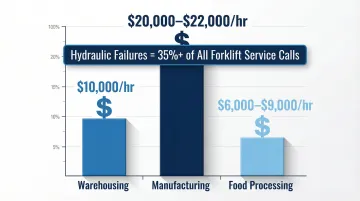
A four-hour hydraulic failure can cost a mid-sized warehouse $40,000 in lost productivity, delayed shipments, and idle labor.
Lifespan Depends on Maintenance Discipline
A well-maintained hydraulic pump can last the operational life of the forklift: 15,000 to 20,000+ hours for piston pumps under ideal conditions. But contaminated hydraulic oil or extreme heat can reduce pump lifespan by 50% or more. Just 250 ppm of water contamination reduces bearing life by a factor of four.
When a pump fails prematurely, the damage compounds fast. You're flushing the entire system, replacing contaminated hoses and fittings, and inspecting cylinders for secondary damage. What $500 in annual maintenance could have prevented becomes a $2,000+ emergency repair.
Safety and Compliance Consequences
Hydraulic pump failures create life-threatening conditions. OSHA Fatality Investigation reports document incidents where failed hydraulic fittings caused sudden mast descent, killing operators. In Case 515205, a leaking hydraulic fitting failed completely, causing uncontrolled mast descent and a fatality.
Mast drift, sudden load drops, and loss of steering assist all stem from hydraulic system degradation. Operating a forklift with known hydraulic defects violates OSHA 29 CFR 1910.178, exposing facility managers to recordable incidents, citations, and direct liability.
Types of Forklift Hydraulic Pump Maintenance
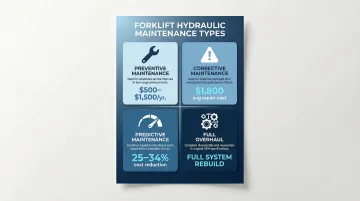
The right maintenance approach depends on operating hours, environment, and current pump condition—not a universal schedule. Here are the four categories and when each applies.
Routine / Preventive Maintenance
In low-to-moderate usage environments with no active symptoms, preventive maintenance is the default strategy—and the lowest-cost option over time.
A standard preventive routine covers:
- Checking hydraulic fluid level and condition daily or per shift
- Inspecting hoses and seals for wear, cracking, or seepage
- Replacing filters at scheduled intervals
- Listening for early cavitation signs during startup
Annual costs run $500–$1,500 for internal combustion forklifts; electric forklifts average $750–$2,000+ due to battery maintenance requirements.
Corrective / Reactive Maintenance
Visible leaks, pressure loss, or a failed lift trigger corrective maintenance. The problem with relying on it as a primary strategy: reactive repairs accelerate secondary damage.
A small seal leak ignored for weeks contaminates the entire fluid reservoir, forcing a complete system flush—and often damaging cylinders, valves, and pump internals that earlier action would have prevented. Reactive hydraulic repairs average $1,800—often 3–4 times the cost of equivalent preventive work once you factor in collateral damage and emergency service premiums.
Predictive / Condition-Based Maintenance
Predictive maintenance uses performance indicators to time interventions before failure occurs—making it the right fit for high-utilization fleets where unplanned downtime is costly.
Key indicators to track:
- Fluid particle counts (contamination trending)
- Pressure gauge readings (output degradation)
- Operating temperature trends (overheating patterns)
- Noise changes (cavitation or bearing wear)
Major / Overhaul Maintenance
A full overhaul is warranted when:
- Pressure loss persists after fluid and filter changes
- Internal wear is confirmed by diagnostics or particle analysis
- Pump age is approaching OEM service life recommendations
The process involves full disassembly, internal component replacement, reassembly to OEM specifications, and pressure testing before the unit returns to service.
Mixed or aging fleets often span multiple manufacturers, which complicates rebuilds. Hydrostatic Pump Repair rebuilds and remanufactures pumps across all major brands to OEM specifications—handling the full rebuild in-house rather than requiring you to coordinate across vendors. Call 800-361-0028 to discuss your application.
Signs Your Forklift Hydraulic Pump Needs Attention
These warning signs often appear gradually—catching them early reduces repair scope and cost.
Performance or Lifting Capacity Changes
Slow or incomplete lifting is an early indicator of pressure loss. Likely causes include:
- Fluid level drop (air entering the system)
- Internal pump wear (reduced output pressure)
- Clogged suction filter (starving the pump)
To distinguish pump vs. cylinder issues: If lifting is slow across all mast functions (raise, tilt, side shift), the pump is likely the culprit. If only one function is affected, inspect the corresponding cylinder or valve first.
Erratic fork movement or delayed response signals air in the system or inconsistent pump output pressure. Symptoms worsen when fluid is cold or the tank is low.
Unusual Noises or Sluggish Operation
Specific sounds to recognize:
- High-pitched whine or grinding: Cavitation or bearing wear
- Knocking or rattling: Internal component damage or air in the fluid
- Intermittent noise that peaks at startup: Low fluid level or suction restriction
Operating with these sounds unaddressed accelerates internal damage — a bearing issue can progress to pump housing failure in a matter of weeks.
Cavitation is the specific mechanism behind many of these failures. It ranks as the second leading cause of hydraulic pump failure, and the violent implosions it generates reach temperatures exceeding 5,000°F — causing localized pitting and metal debris throughout the system.
Visible Leaks, Fluid Condition, and Overheating
External leaks: Oil pooling under the forklift, wet fittings, or deteriorating hose surfaces all indicate external leakage. Inspect pump mounting points, hose connections, and cylinder rods.
Internal leakage signs: Pressure loss with no visible external leak suggests internal seal wear. The pump runs but can't maintain pressure under load.
Assess fluid condition:
| Fluid Appearance | What It Indicates | Required Action |
|---|---|---|
| Milky or cloudy | Water contamination | Stop water influx; flush system or use water-absorbing filters |
| Dark or burnt smell | Overheating, oxidation, or air entrainment | Analyze fluid chemically; check for air leaks in suction lines |
| Metallic particles | Internal wear, abrasion, or cavitation damage | Flush entire system; remove pump for internal inspection |
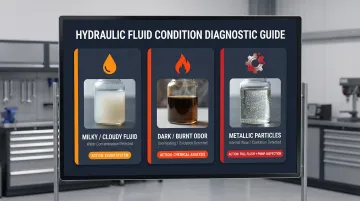
Any of these conditions calls for an immediate fluid change and system inspection — don't run the forklift until the cause is identified.
Forklift Hydraulic Pump Maintenance Schedule
Maintenance intervals are guidelines, not guarantees. High-dust environments, continuous multi-shift operation, and elevated temperatures all shorten the intervals below — adjust accordingly for your operating conditions.
The schedule below covers standard forklift hydraulic pump maintenance. Use it as a baseline, then apply the condition-based adjustments at the bottom to fit your actual environment.
Maintenance Frequency Reference
Daily / Per-Shift:
- Hydraulic fluid level check
- Visual inspection for leaks around pump, hoses, and fittings
- Listen for abnormal pump noise during startup
Every 500 Hours:
- Hydraulic filter replacement
- Hose and seal inspection
- Pressure check against manufacturer spec
Every 1,000 Hours (or Annually):
- Full hydraulic fluid change (Toyota recommends every 1,000 hours)
- Suction filter inspection
- Pump output pressure test
- Cylinder seal inspection
Every 2,000–4,000 Hours:
- Full pump inspection; overhaul if wear exceeds tolerance
- System flush if contamination is present
- Review of all hydraulic component wear
These intervals assume standard operating conditions. If your forklift runs harder or in harsher environments, the section below explains how to adjust.
Adjusting for Operating Conditions
| Operating Condition | Fluid Change | Filter Replacement |
|---|---|---|
| Standard (intermittent, climate-controlled) | Every 1,000 hours | Every 500 hours |
| High-demand (multi-shift, outdoor, dusty) | Every 500 hours | Every 250 hours |
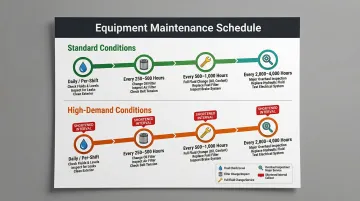
When in doubt, treat your environment as high-demand. The cost of an extra fluid change is far lower than an unplanned pump failure.
Conclusion
Forklift hydraulic pump maintenance is a direct investment in equipment lifespan, operator safety, and operational continuity. A structured maintenance plan costs far less than a single unplanned pump failure — which can trigger $10,000+ in downtime costs within hours.
When maintenance reveals pump wear beyond in-house capability, or sourcing parts for older forklift models becomes a barrier, Hydrostatic Pump Repair offers pump rebuilds and remanufacturing across all major manufacturers — including access to components for hard-to-find equipment. Contact them at 800-361-0028.
Frequently Asked Questions
How much does it cost to repair hydraulics on a forklift?
Minor seal or fluid repairs typically cost $500–$1,000, while full pump rebuilds range from $1,800 to $3,000+ depending on forklift brand, pump type, and whether OEM parts are required. A diagnostic inspection before any rebuild confirms exactly what's failed — and prevents paying for repairs that won't fix the root cause.
What is the common problem of a hydraulic pump?
The most common issues are internal seal wear causing pressure loss, cavitation from low fluid or suction restrictions, contamination from dirty or degraded oil, and overheating from blocked filters or overloaded operation. Contamination is the leading cause of premature pump failure.
What are the most common forklift repairs?
Hydraulic-related repairs—leaks, pump wear, and cylinder issues—rank among the most frequent forklift repairs, alongside mast chain and brake maintenance. Most hydraulic repairs are preventable with scheduled maintenance and fluid cleanliness discipline.
What does OSHA require to be done with any forklift that is in need of repair or in any way unsafe?
OSHA 29 CFR 1910.178 requires any forklift found to be unsafe to be immediately removed from service, tagged out, and not returned to operation until inspected and authorized as safe by qualified personnel. Daily pre-shift inspections are mandatory.
How often should forklift hydraulic oil be changed?
The general industry standard is every 1,000 operating hours or once per year, whichever comes first. Contaminated, discolored, or burnt-smelling oil should be changed immediately regardless of hours to prevent accelerated pump wear.
What is the maintenance procedure in SOP for forklift hydraulics?
A standard hydraulic maintenance SOP covers:
- Pre-shift fluid level and leak checks
- Scheduled filter and oil changes tied to operating hours
- Pressure testing at defined service intervals
- Documentation of all inspections and repairs for compliance records