Introduction
Most heavy equipment operators know the engine and transmission drive their machines, but the component that actually delivers usable power to the tracks or wheels—the final drive assembly—is often overlooked until it fails. When a final drive goes, the machine stops. That means unplanned downtime, costly repairs, and lost productivity—often at the worst possible moment.
This guide covers what a final drive assembly is, how it works, the critical parts inside, the different types you'll encounter, and how to spot early warning signs before a failure sidelines your equipment.
TLDR:
- Final drives convert high-speed motor output into the massive torque needed to move tracks or wheels
- Planetary gear systems typically multiply torque by 20:1 to 50:1 across multiple load-sharing gears
- Seal failure is the #1 cause of final drive destruction—oil loss leads to rapid gear and bearing wear
- Warning signs include grinding noise, oil leaks, and loss of travel speed or pulling to one side
- Catching problems early—through regular oil checks and noise monitoring—dramatically extends final drive service life
What Is a Final Drive Assembly?
A final drive assembly is the last stage in a machine's power transmission system. It converts high-speed, low-torque input from the transmission into the low-speed, high-torque output needed to move wheels, tracks, or sprockets. The word "final" is literal — this is where gear reduction happens before power reaches the ground.
Where the Final Drive Lives on Your Machine
The physical location of the final drive depends on whether your equipment runs on tracks or wheels:
Tracked Equipment (Excavators, Dozers, Compact Track Loaders):
- Two separate final drive units—one per track
- Mounted at the rear of each track frame
- Directly connected to the drive sprocket that engages the track chain
- Located opposite the blade or idler wheel
Wheeled Equipment (Wheel Loaders, Articulated Haulers):
- Integrated into or mounted at the wheel hubs
- Often called "hub reduction" gears
- Positioned at the ends of the drive axles
Final Drive vs. Differential: What's the Difference?
The final drive and differential are often confused, but they do different jobs. The final drive performs gear reduction and torque multiplication — it's a fixed-ratio gearbox. The differential manages speed differences between two wheels during turns, allowing the outside wheel to rotate faster than the inside.
In many wheeled assemblies, the final drive and differential are housed together and function as a combined unit. On tracked excavators and dozers, there is no differential—steering is achieved by independently controlling the speed and direction of the left and right hydraulic travel motors.
Why Final Drives Matter
Without gear reduction at this final stage, upstream components — shafts, bearings, transmission gears — would absorb enormous torque loads with every movement. The final drive distributes that stress across multiple gears, which is why a worn or failing final drive puts the entire drivetrain at risk. Catching final drive issues early protects the more expensive components behind it.
Key Components of a Final Drive Assembly
Hydraulic Motor (Tracked and Hydrostatic Machines)
On most modern excavators and tracked equipment, the input to the final drive is a hydraulic travel motor powered by hydraulic fluid from the machine's pump system. The motor converts hydraulic pressure into rotational force that feeds into the gear reduction assembly.
The hydraulic motor is a serviceable component — and one of the most frequently repaired. Hydrostatic Pump Repair rebuilds and remanufactures hydraulic drive motors to OEM specifications, covering piston, gear, and vane motor types from manufacturers including Sundstrand, Danfoss, Eaton, Kawasaki, Komatsu, Rexroth, and Uchida.
Sun Gear
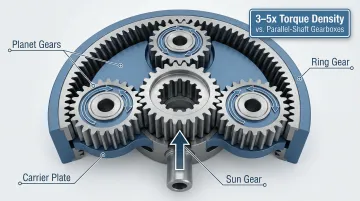
The sun gear is the central gear at the core of the planetary gear system. It's connected to the rotating shaft of the hydraulic motor or input shaft and receives the initial rotational force. As the sun gear turns, it drives the surrounding planet gears.
Planetary Gears and Carrier
Planet gears orbit the sun gear—similar to planets around the sun—and are held together by a carrier plate. Many final drives use two stages of planetary gears (an inner and outer set) to achieve higher gear reduction ratios. This dual-stage design is standard in heavy dozers, excavators, and rigid haulers.
Multiple planet gears share the load simultaneously, which increases torque capacity and durability. Planetary systems can achieve torque densities 3 to 5 times higher than parallel-shaft gearboxes of the same size.
Ring Gear
The ring gear is the fixed outer gear that surrounds the planet gears. It has internal teeth that the planet gears roll along. This interaction converts the input rotation into amplified torque output. The size ratio between the sun gear and ring gear determines the final drive reduction ratio—larger ratios mean more torque and slower travel speeds.
Housing, Bearings, and Seals
Three sub-components work together to protect the final drive's internals:
- Housing — Contains all components in a bath of oil and absorbs external impact loads
- Bearings — Allow gears and shafts to rotate with minimal friction under heavy radial and axial loads
- Seals — O-rings, Duo-Cone, or mechanical face seals keep lubricant in and contaminants (dirt, water, debris) out
Seal failure is the most common cause of final drive damage. When seals fail, oil leaks out, leading to rapid gear and bearing wear. Contamination ingress accelerates destruction. A leaking seal must trigger immediate machine shutdown to prevent costly planetary gear and housing damage.
How a Final Drive Assembly Works
Power Flow from Engine to Ground
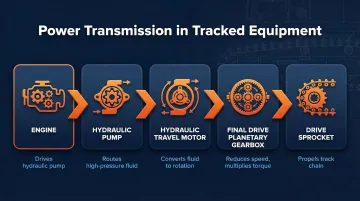
In modern tracked equipment, power flows through a precise electro-hydraulic and mechanical path:
- Engine drives the main hydraulic pump
- Hydraulic pump routes high-pressure fluid to the hydraulic travel motor
- Hydraulic travel motor converts fluid pressure into high-speed rotational energy
- Final drive planetary gearbox reduces speed and multiplies torque
- Drive sprocket (bolted to the final drive output shaft) engages the track chain to propel the machine
On wheeled equipment, output goes to the axle shaft and then to the wheels.
Gear Reduction in Practical Terms
The planetary gear system inside the final drive takes high-RPM, low-torque rotation from the hydraulic motor and converts it to slow-turning, high-torque output. Typical gear reduction ratios for heavy equipment final drives range from 20:1 to 50:1.
Examples of Real-World Ratios:
- Standard excavators: 20:1 to 30:1
- Cat 785D mining truck: 22.75:1 total (2.10:1 differential, 10.83:1 planetary)
- Cat 777 off-highway truck: 19.16:1 total (2.74:1 differential, 7.00:1 planetary)
A 30:1 ratio means the hydraulic motor spins 30 times for every single rotation of the drive sprocket. That ratio multiplies available torque by the same factor — which is what gives heavy equipment the force to break ground, climb grades, and move loaded material.
Differential Function in Wheeled Equipment
On wheeled equipment with a combined final drive and differential assembly, the differential gears allow the left and right wheels to rotate at different speeds during turns. This prevents tire scrub and drivetrain binding.
On tracked machines, each track has its own independent final drive, so differential action is managed by the machine's hydraulic control system rather than internal gearing.
How Reduction Ratio Affects Performance
Reduction ratio directly shapes how a machine behaves in the field:
- Higher ratio (e.g., 45:1) — more torque, lower travel speed; suited for steep grades and heavy pushing
- Lower ratio (e.g., 20:1) — faster travel speed, less torque; better for machines covering ground between work sites
When a machine feels sluggish under load or struggles on grades it previously handled, the ratio itself isn't changing — but worn gears, low oil, or a failing hydraulic motor can make it perform as if it were undergeared. That distinction matters when troubleshooting.
Types of Final Drive Assemblies
Planetary Gear Final Drives
This is the most common type in modern heavy construction equipment and tracked machines. The planetary (epicyclic) gear system distributes load across multiple planet gears simultaneously, enabling high torque capacity in a compact, durable design.
Many heavy-duty units use two stages of planetary reduction to achieve the massive torque required by dozers, excavators, and mining equipment, reducing gear tooth stresses while maximizing tractive effort.
Bevel Gear Final Drives (Spiral Bevel and Hypoid)
Bevel gear designs appear more often in wheeled vehicles and older equipment, where torque must transfer at a 90-degree angle. Three main configurations exist:
- Spiral bevel: Uses angled, curved teeth on a pinion and ring gear — the standard setup in rear-axle differentials on trucks
- Hypoid: Offsets the pinion from the ring gear centerline, increasing contact area and strength; quieter and more durable than spiral bevel, but generates more friction and requires extreme pressure (EP) lubricants
- Double-reduction: Combines a differential (first stage) with a planetary hub reduction (second stage) to deliver high torque in heavy-duty trucks without an oversized ring gear
Open Differential vs. Limited-Slip Differential Assembly
Open Differential:
- Distributes torque equally between two outputs
- Loses traction if one wheel slips
- Standard on most wheeled equipment
Limited-Slip Differential (LSD):
- Uses clutch packs or gear-based mechanisms to redirect torque to the wheel with better traction
- Important for off-road and heavy equipment applications
- Prevents spin-outs in muddy or loose ground conditions
Signs Your Final Drive Assembly Is Failing
Abnormal Noise
Listen for these warning sounds:
- Grinding or growling during travel — indicates worn gears or bearings
- Whining or high-pitched sounds — signals insufficient lubrication or early bearing failure
- Clicking or popping under load — indicates damaged gear teeth
Do not continue running a machine with unexplained drivetrain noise. What starts as a minor bearing issue can quickly escalate to complete planetary gear destruction.
Oil Leaks and Contamination
Visible oil weeping around the final drive housing is a serious warning sign of seal or O-ring failure. Inspect the magnetic drain plug during every scheduled PM service—metallic debris (silver glitter or shavings) provides early warning of bearing or gear fatigue.
Contaminated oil symptoms:
- Milky or cloudy oil indicates water intrusion through a compromised seal
- Metallic particles or shavings point to active internal gear or bearing wear
- Dark oil with a burnt smell suggests overheating or fluid oxidation
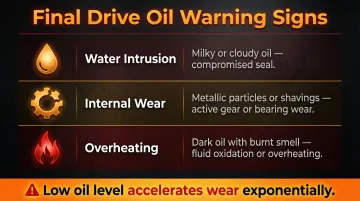
Low oil level accelerates wear exponentially. A leaking seal also lets mud, sand, and water into the planetary hub—turning external debris into a grinding compound inside the gearbox.
Reduced Power, Travel Speed, or Abnormal Pulling
If your machine pulls to one side, loses travel speed under load, or struggles on terrain it previously handled easily, the final drive assembly may have worn gears, a failing hydraulic motor, or internal damage affecting gear reduction efficiency.
Once you've identified the symptoms, getting the right repair done quickly is the next step. Hydrostatic Pump Repair specializes in rebuilding and remanufacturing hydraulic travel motors across a wide range of equipment manufacturers, including hard-to-find brands. They offer remanufactured and exchange units to get machines back in service faster. Call 800-361-0028 for technical support and a quote.
Frequently Asked Questions
What is a final drive assembly?
A final drive assembly is the last stage of a machine or vehicle's power transmission system, responsible for reducing rotational speed and multiplying torque before delivering power to the wheels, tracks, or sprockets.
What is the purpose of the final drive assembly?
Its primary purpose is gear reduction — converting high-speed, low-torque input from the transmission or hydraulic motor into the slow-speed, high-torque output needed to move heavy loads efficiently and protect upstream drivetrain components.
What are the major components of a final drive assembly?
Core parts include the hydraulic motor (on tracked machines), sun gear, planetary gears and carrier, ring gear, output shaft, housing, bearings, and seals — each essential to torque multiplication and long-term durability.
How does a final drive differential assembly work?
The differential portion allows two wheels to rotate at different speeds during turns, while the final drive portion reduces gear ratio and multiplies torque. Together — often sharing a single housing — they deliver power efficiently while preserving steering control.
What are two common types of final drive differential assemblies?
The open differential splits torque equally between two outputs but loses effectiveness when one wheel loses traction. The limited-slip differential uses clutch packs or Torsen-style gearing to redirect torque to the wheel with more grip.
How do I know if my final drive is bad?
Common symptoms include grinding, whining, or clicking noises during travel; oil leaks or contaminated gear oil around the housing; and reduced travel speed, loss of pulling power, or the machine drifting to one side under load.