Introduction
The bulldozer final drive is the critical link between hydraulic power and track movement: without it, the machine cannot move or push. This sealed, self-contained unit combines a hydrostatic travel motor and planetary reduction gearbox to convert high-speed, low-torque hydraulic input into the slow, high-torque output needed to drive the tracks.
Final drive failures on bulldozers are predictable and often preventable. Constant pushing loads, blade resistance, and frequent directional reversals place unusually high stress on internal components compared to other tracked equipment.
Most failures go undetected until a visible symptom surfaces — oil leaks, grinding noise, or power loss. At that point, knowing what's wrong and how to respond determines whether you're looking at a targeted repair or a full replacement.
This guide covers the most common final drive problems on bulldozers, how to diagnose them accurately, a step-by-step repair process, and a practical framework for deciding when repair makes sense — and when it doesn't.
Key Takeaways
- Oil leaks, excessive noise, track power loss, overheating, and gear or bearing wear are the most common final drive problems
- Catch problems early and most can be repaired; catastrophic internal failures typically require full replacement
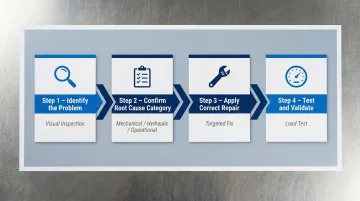
- Repair process follows four steps: identify the symptom, confirm the root cause, apply the correct fix, then test under load
- Call a professional for hydraulic motor disassembly, internal gear damage, or any failure producing metal debris in the oil
What Is a Bulldozer Final Drive?
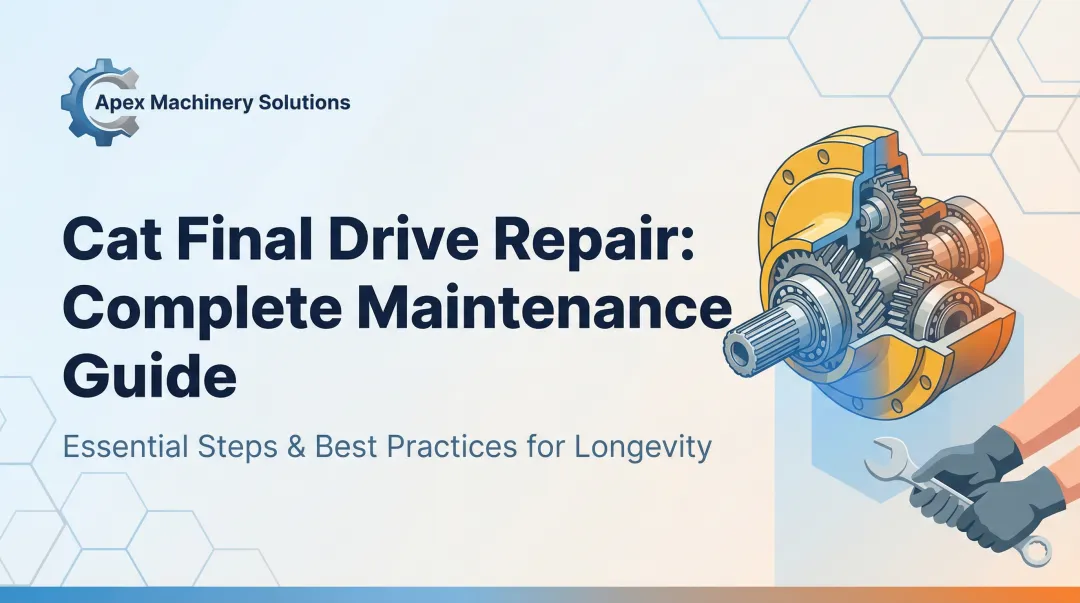
The final drive is the last stage in a bulldozer's drivetrain. It consists of a hydraulic (hydrostatic) travel motor and a planetary reduction gearbox that work together as a single, sealed unit. The motor receives high-speed, low-torque hydraulic flow from the main pump, and the planetary gearbox reduces that speed while multiplying torque to move the tracks.
Bulldozers place unusually high stress on final drives compared to excavators or loaders. Constant pushing loads, blade resistance, and frequent directional reversals accelerate wear on gears, bearings, and seals. The final drive handles the highest torque multiplication in the entire drivetrain — making it one of the most heavily stressed components on the machine.
Because the system is sealed and self-contained, internal degradation happens silently. Most operators don't realize anything is wrong until a visible symptom appears:
- Oil pooling beneath the machine after shutdown
- Grinding or whining noise during travel
- One track losing pulling power or speed
- Unusual heat coming from the drive housing
Catching these signs early is the difference between a rebuild and a full replacement.
Common Bulldozer Final Drive Problems and Root Causes
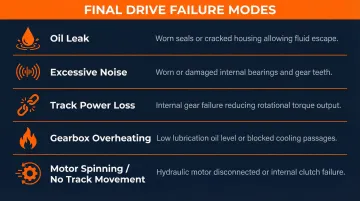
Most final drive failures follow predictable patterns tied to lubrication, load, or contamination. Catching them early cuts repair costs — sometimes by half — and keeps a manageable fix from turning into a full rebuild. Here are the five most common failure modes and what drives them.
Oil Leaking from the Gearbox or Ring Gear
Symptoms:
- Visible oil pooling under the final drive
- Wet residue around the ring gear or cover plate
- Dropping gear oil level between service intervals
Root cause: Worn or damaged floating face seals (duo-cone seals) account for 40–50% of all reported dozer final drive problems. A distorted cover plate or worn bearing seals between the motor and gearbox can also be the culprit.
If the leak is pressure-related, don't wait — prolonged build-up can rupture the gearbox entirely.
Excessive Noise from the Final Drive
Symptoms:
- Grinding, whining, or knocking sounds during travel
- Noise intensifies under load or when changing direction
What's happening: Low gear oil (typically from an undetected leak), contaminated oil carrying metal particles, or gears and bearings that have reached end of service life. Metal-contaminated oil is particularly destructive — it accelerates wear on every surface it contacts.
Loss of Track Power or Difficulty Moving Under Load
Symptoms:
- One track moves slower than the other
- Bulldozer struggles to push or climb grades
- Sluggish response when engaging travel
Why this occurs: Low hydraulic pressure in the hydrostatic travel motor is the first thing to check. Internal wear in the motor's cylinder block or friction plate and a worn gearbox that can no longer transmit full torque to the sprocket are the other common causes.
Gearbox Overheating
Symptoms:
- Unusually hot casing around the final drive
- Gear oil that darkens or smells burnt
- Heat-related seal failure
Root cause: Low gear oil level or wrong oil specification are the quickest checks. Worn bearings generating excess friction and restricted cooling airflow around the housing — common in tight, debris-heavy environments — round out the usual suspects.
Motor Spinning but Track Not Moving
Symptoms:
- Hydraulic motor appears to be running (audible operation)
- Track does not turn or turns with very little force
What's happening: A broken motor shaft, stripped sun gear, or failed drive shaft. Any of these breaks the mechanical link between the motor and the planetary gear set — the drive turns, but nothing moves. This failure mode typically requires disassembly to confirm which component let go.
How to Fix a Bulldozer Final Drive: Step-by-Step
Attempting a repair without first confirming the root cause wastes time and parts. The four-step process below ensures the right fix is applied the first time.
Step 1: Identify the Exact Problem
Conduct a visual walkaround:
- Look for oil seepage around the ring gear, cover plate, and hydraulic connections
- Note any discoloration or heat damage on the casing
- Check for packed debris around seals
Operate the bulldozer briefly (safely) and document symptoms:
- Does the noise occur at startup, under load, or continuously?
- Does track power loss affect one side or both?
- Does the gearbox become hot faster than normal?
Check gear oil level and condition:
- Pull the fill plug and inspect color, viscosity, and the presence of metal shavings
- Metal debris in the oil is a critical warning sign requiring immediate escalation
- Fine metal particles adhering to the magnetic fill/drain plug are normal; larger metal particles such as gear teeth, bearing fragments, or metal shavings are not
Step 2: Confirm the Root Cause Category
Failures fall into three categories — identify which applies before touching any parts:
- Mechanical: gears, bearings, shafts, seals
- Hydraulic: motor pressure, fluid contamination, internal motor wear
- Operational/Environmental: overloading, incorrect oil, working conditions
Rule out external causes first:
- Verify hydraulic system pressure from the main pump is within specification before assuming the final drive motor has failed internally
- Check for restricted flow to the travel motor
- Confirm charge pressure is adequate
Don't replace parts based on symptoms alone. A noisy final drive caused by contaminated oil needs a different fix than one with worn bearings — misdiagnosis leads to repeat failure.
Step 3: Apply the Correct Repair
This step varies entirely based on what is wrong. It is where most repair cost and error occurs if diagnosis was skipped or rushed.
If the Issue Is an Oil Leak or Seal Failure
- Replace floating face seals (duo-cone seals) if leaking from the ring gear area; these have a finite lifespan and cannot be reused once removed
- Inspect the gearbox cover plate for warping or damage; replace if distorted
- If the leak is pressure-driven, check the bearing and seal between the motor and gearbox before reassembly
If the Issue Is Gear, Bearing, or Shaft Damage
Inspect gear teeth:
- Pointed tooth tips indicate the gear set is worn out and must be replaced as a complete set
- Never replace only one gear — a drive pinion and ring gear are machined as a matched set
- Check drive shaft splines for the same pointed wear pattern
Inspect bearings:
- Look for play, pitting, or surface scoring
- Worn bearings require full replacement and should be installed with correct preload and alignment to prevent recurrence
For a broken motor shaft or sun gear:
- Replace both the shaft and the first drive gear together, as the mating component is typically damaged as well
If the Issue Is on the Hydraulic Motor Side
Check hydraulic fluid level and pressure:
- Low charge pressure from the main pump or a weak charge pump is a common root cause of motor-side power loss on bulldozers
Inspect the cylinder block and friction plate inside the travel motor:
- Disassembling the hydrostatic motor requires precision tooling and manufacturer specs — this is where a professional hydraulic repair service typically adds the most value. Hydrostatic Pump Repair rebuilds travel motors to OEM specifications for bulldozer and construction equipment applications.
Flush the hydraulic system if contamination has occurred:
- A fluid change alone is not sufficient after a catastrophic internal failure
- Complete system flushing is required, involving circulating special, clean oil through the entire circuit
If the Issue Is Operational or Environmental
Correct oil specification errors immediately:
- Using the wrong gear oil can accelerate gear and bearing wear
- Research and confirm the OEM-recommended oil grade for the specific bulldozer model
Address overloading habits with operators:
- Bulldozers used consistently above rated blade capacity put disproportionate stress on final drive gears
- Excessive heat in hydraulic systems thins the oil, increases fluid oxidation, and bakes seals
Step 4: Test and Validate the Repair
Before starting:
- Add the correct amount of gear oil to the planetary hub and hydraulic fluid to the motor
- A dry start will cause immediate damage and void any warranty on replaced parts
- Hydraulic motor casings must be filled with oil through the drain port prior to start-up; filling only the suction line is totally insufficient
Once fluid levels are confirmed, move the machine through its full travel range before putting it under load.
Run the bulldozer through normal travel:
- Operate in both directions and under representative load conditions
- Monitor for recurrence of noise, leaks, or power loss
Recheck after initial operation:
- Inspect gear oil level after the first few operating hours post-repair
- Look for new seepage around seals and cover plates
Fix vs. Replace: Making the Right Call
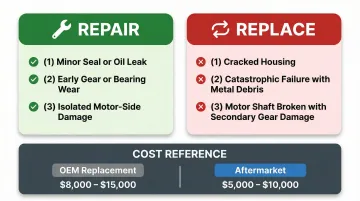
Early-stage repairs on a bulldozer final drive can cost a fraction of full replacement. However, advanced internal failure often makes repair economically irrational. Knowing which situation you are in is essential before committing to either path.
The four scenarios below cover the most common decision points:
Scenario 1: Minor Seal or Oil Leak
Fix: Replace floating face seals or cover plate; low cost, straightforward repair that restores sealing integrity and prevents further oil loss
Replace: Only if the housing or mounting face is cracked or severely corroded, making a proper seal seat impossible
Scenario 2: Worn Gears or Bearings Detected Early
Fix: Replace the affected gear set and bearings before complete failure; parts are still largely reusable and the repair can be scheduled rather than forced by breakdown
Replace: If inspection reveals that the gear housing, carrier, or shaft bores are damaged beyond tolerance — internal housing damage makes rebuilding impractical, as parts and labor often exceed the cost of a replacement unit
Scenario 3: Hydraulic Motor Internal Failure
Fix: Motor-side repairs (cylinder block, friction plate, piston replacement) are worth pursuing when damage is isolated. Hydrostatic Pump Repair services travel motors across all major bulldozer brands, rebuilding to manufacturer specifications with warranty coverage on every unit — typically at well under replacement cost.
Replace: If the motor shaft is broken and has caused secondary damage to the first-stage gearing, or if contamination has caused widespread scoring throughout the motor internals, full unit replacement is more reliable at lower total cost
Scenario 4: Catastrophic Failure with Metal Debris in Oil
Fix: Not recommended. Once large metal fragments are found in the oil or on the magnetic drain plug, cascading damage across gears, bearings, and motor internals is typically already in progress.
Replace: Full final drive replacement is the standard recommendation after catastrophic failure. Attempting to rebuild at this stage rarely delivers long-term reliability. Total repair costs frequently approach or exceed new unit pricing. OEM final drives range from $8,000–$15,000, while premium aftermarket units cost $5,000–$10,000.
Mistakes to Avoid and Preventive Maintenance
Most final drive failures trace back to a handful of avoidable errors during repair or routine maintenance. Watch for these common mistakes:
- Treating symptoms, not root cause — Replacing seals on a pressurized gearbox without investigating why pressure built up will result in repeat failure within a short interval.
- Skipping the dry-start check — Failing to fill the planetary hub with gear oil and the motor with hydraulic fluid before first startup is one of the most common causes of immediate post-repair damage.
- Using the wrong oil — Confirm OEM oil specifications before filling. The wrong grade degrades gear and seal life and can void warranties on rebuilt components.
- Neglecting oil changes — Final drive gear oil should be changed every 1,000 hours under normal conditions, and at half that interval in harsh environments. Contaminated oil is the single most preventable cause of premature failure.
Building a Preventive Maintenance Schedule
A consistent maintenance routine keeps final drives running longer and repair costs predictable:
- Check gear oil levels and inspect seals at regular intervals
- Sample oil periodically to detect wear metals before symptoms appear
- Train operators on load limits and correct directional change procedures
- Maintain accurate service records to track component hours and anticipate repair windows
- Pressure wash the undercarriage regularly to protect face seals from packed debris
Frequently Asked Questions
Can a final drive be repaired?
Yes, final drive repair is possible in many cases. Minor issues like worn seals, low oil, or early bearing wear are cost-effective to repair. However, catastrophic internal failures involving broken shafts, debris-contaminated oil, or widespread gear damage often make full replacement the more practical choice.
What are the symptoms of bulldozer final drive failure?
Key warning signs include unusual grinding or whining noise during travel, oil leaks around the ring gear or cover plate, loss of track power on one or both sides, gearbox overheating, and the track failing to move despite the motor running.
What is the most common cause of final drive failure on a bulldozer?
Contaminated or insufficient gear oil is the leading preventable cause. Metal particles accelerate gear and bearing wear, while low oil levels cause overheating and seal failure. Constant pushing loads and frequent direction changes compound this damage when lubrication is neglected.
How often should bulldozer final drive oil be changed?
The standard interval is every 1,000 operating hours under normal conditions. Bulldozers operating in harsh conditions such as extreme heat, mud, or heavy push cycles may require more frequent changes and oil sampling to prevent premature wear.
When should I replace instead of repair a bulldozer final drive?
Replacement is typically the better option when large metal fragments are found in the oil, the motor shaft or gear housing is broken, or repair costs approach the price of a remanufactured unit.
How long does a bulldozer final drive last?
With proper maintenance, bulldozer final drives can last several thousand operating hours — OEM units typically reach 8,000–12,000 hours. Actual lifespan depends on load intensity, oil maintenance habits, and how quickly early warning signs are caught.